

So, you want to build an affiliate marketing business? At its core, the process comes down to four major steps: finding a profitable niche you actually care about, building a platform (like a blog or YouTube channel) to share your knowledge, attracting the right audience, and then promoting products that genuinely help them.
It's definitely a long game, not an overnight success story, but following a proven framework is the surest way to build a real, sustainable income online.
Your Blueprint for a Profitable Affiliate Business
Think of this as your launchpad for building a legitimate affiliate marketing business. We're going to skip all the "get rich quick" nonsense and focus on the real, actionable strategies that can turn a side hustle into a reliable income stream. This guide is your playbook, walking you through everything from finding a niche you'll love to setting up your website and getting your first visitors.
The Opportunity in Affiliate Marketing
Jumping into affiliate marketing now means getting in on a massive, growing industry. In 2024, the global market was valued at a staggering $27.8 billion, with projections showing it could hit $48 billion by 2027.
Why the boom? Businesses love this model. Over 80% of brands use affiliate marketing because they only pay for actual results—leads and sales. It's a cornerstone of digital advertising, not just some passing trend. If you want to see the full picture, diving into more affiliate marketing statistics really highlights the growth.
This all creates a huge opening for creators like you. As more companies get on board, they're desperate for authentic, knowledgeable affiliates who can connect them with the right customers. Your unique voice and expertise are exactly what they're looking for.
Mapping Out Your Journey
The road ahead feels a lot less intimidating when you can see the milestones. This timeline lays out the big-picture stages, from the initial idea all the way to generating traffic and making money.
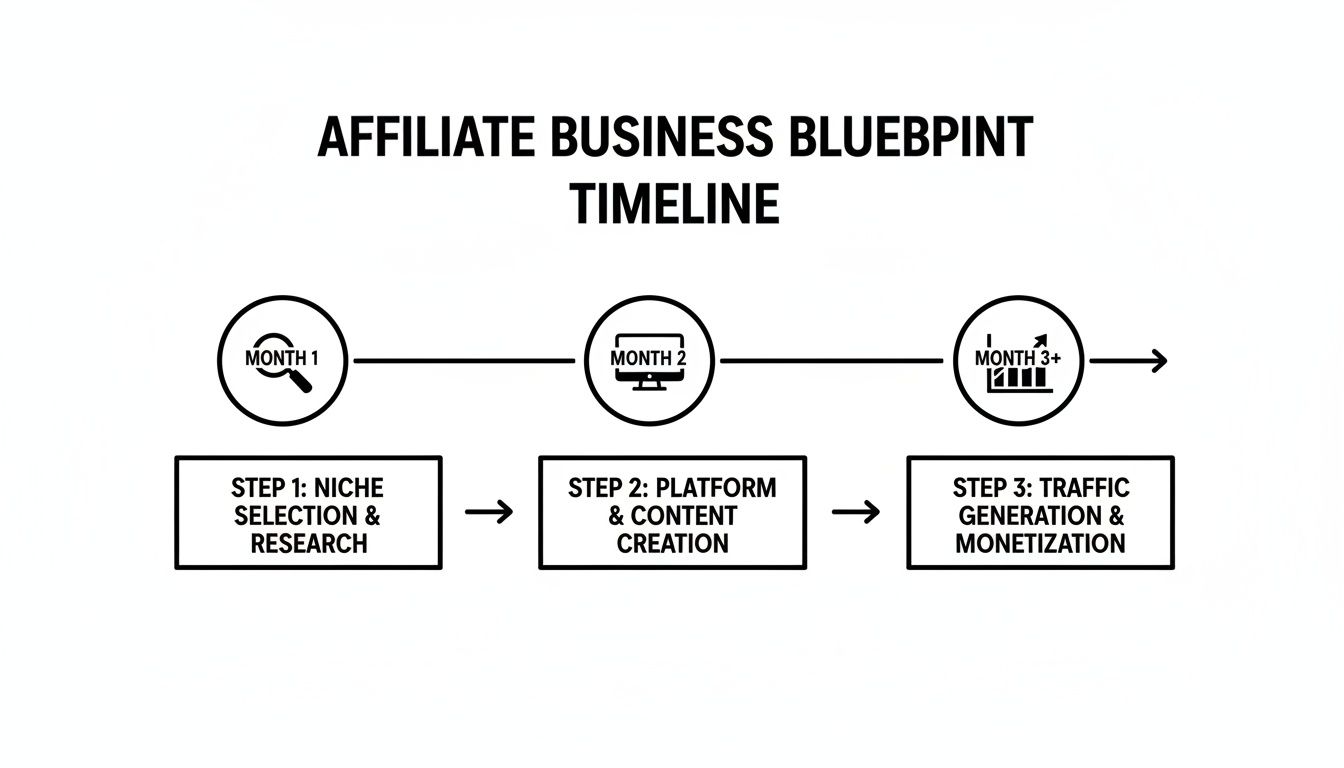
As you can see, success isn't a single "aha!" moment. It's a series of deliberate steps, starting with a solid foundation in niche research before you even think about writing content or choosing products.
What does this mean for you? You don't have to figure everything out on day one. Just focus your energy on one phase at a time, build some momentum, and then move on to the next. This entire guide is structured to follow that exact path, giving you a clear framework to build upon.
Key Takeaway: A successful affiliate business is built methodically. Focus on mastering each stage—niche selection, platform creation, and traffic generation—before trying to do everything at once. This sequential approach prevents overwhelm and builds a stronger, more resilient business.
Here’s a quick summary of the essential phases for starting your affiliate marketing business. This checklist provides a high-level overview of the entire process.
Affiliate Marketing Business Launch Checklist
| Phase | Key Objective | Main Tasks |
|---|---|---|
| Foundation (Months 1-2) | Niche & Legal Setup | Research profitable niches. Define target audience. Select business model. Handle legal registration (LLC, etc.). |
| Build (Months 2-4) | Platform & Content | Choose your platform (blog, YouTube). Set up your website/channel. Start creating high-quality content. |
| Launch & Promote (Months 3-6) | Traffic & Monetization | Select and join affiliate programs. Implement traffic strategies (SEO, social media). Build an email list. |
| Optimize & Scale (Months 6+) | Growth & Revenue | Analyze performance with analytics. Optimize for conversions. Scale traffic with paid ads or expanded content. |
This checklist isn't meant to be rigid, but it gives you a solid idea of the flow from one stage to the next. The key is to keep making consistent progress.
Finding Your Niche and Profitable Products
Alright, let's talk about the single most important decision you'll make in this entire journey: choosing your niche. Get this right, and everything else becomes ten times easier. Get it wrong, and you're setting yourself up for a long, frustrating grind.
A lot of beginners make the mistake of picking a niche just because they hear it's profitable. That's a recipe for burnout. The real magic happens at the intersection of three things: your genuine interests, real audience demand, and a solid selection of affiliate products.
When you're actually passionate about a topic, creating content doesn't feel like a chore. That authenticity is magnetic, and it's the bedrock of building trust with an audience.
So, what are you into? Think about your hobbies, the skills you've picked up at your job, or that one topic you can't stop talking about with friends. Are you obsessed with home espresso machines? An expert in sustainable gardening? Do you know all the best project management hacks for small teams? Any of these could be the seed of a fantastic affiliate business.
Brainstorming and Validating Your Niche Idea
Got a few ideas floating around? Great. Now we need to see if they can actually make money. A passion project is wonderful, but a business needs an audience that's actively searching for answers and is willing to buy things. The good news is, you can do this research for free.
First, pop your ideas into Google Trends. This will quickly tell you if interest in your topic is growing, dying, or just a seasonal fad. For example, a niche like "eco-friendly cleaning supplies" probably has steady, year-round interest. On the other hand, something like "outdoor pizza ovens" will likely spike in the summer.
Next, it's time to dig into what people are actually searching for. Free tools like the Ahrefs Free Keyword Generator or Ubersuggest are perfect for this. If your niche is "home coffee brewing," are people looking for "best espresso machine under $500" or "how to make cold brew at home"? Seeing these kinds of searches is a huge green light—it means you have an active audience with problems to solve.
Here’s a quick checklist for your niche ideas:
- Passion and Expertise: Could you talk or write about this for years without getting sick of it? Your enthusiasm is your biggest asset.
- Audience Size: You need a group big enough to support a business, but not so massive that you're competing with giants. "Fitness" is way too broad. "Kettlebell workouts for busy parents" is getting much warmer.
- Monetization Potential: Are there quality affiliate products out there? More importantly, do people in this niche actually spend money online?
I can't stress this enough: do not skip the validation step. I've seen too many people build beautiful websites around a niche with zero search demand, only to wonder why it's a ghost town six months later.
Selecting Profitable and Ethical Affiliate Products
Once you've locked in a solid niche, it's time for the fun part: finding products to promote. Remember, every product you recommend is a reflection of your brand. Promoting junk is the fastest way to burn through the trust you’ve worked so hard to build.
A great place to start is with products you already use and genuinely love. Does that amazing software you use every day have an affiliate program? What about those hiking boots you recommend to everyone you know? Personal experience is the most powerful sales tool you have.
To find more opportunities, a simple Google search for "[your niche] + affiliate programs" works wonders. This will uncover both individual company programs and big affiliate networks like ShareASale, CJ Affiliate, and Impact, where you can find thousands of potential partners.
When you're sizing up a potential affiliate program, don't just get blinded by the commission rate. You need to look at the whole picture:
- Commission Structure: Is it a one-time payout (like 5% on a physical product) or a recurring commission (20% every month for a subscription)? Recurring commissions are the key to building a more predictable, stable income.
- Cookie Duration: This is how long you get credit for a sale after someone clicks your link. A 30-day or 90-day cookie is way better than a 24-hour one, giving your reader plenty of time to make a decision.
- Merchant Reputation: Is the company known for quality and good customer service? A quick hunt for reviews will tell you everything you need to know. Tying your name to a bad company will only damage your own reputation.
Think about our home coffee niche again. You might promote a high-end espresso machine from Amazon that has a low 3% commission but a high price tag, leading to a decent payout. At the same time, you could promote a coffee bean subscription service that offers a 15% recurring commission. A smart strategy usually involves a mix of both high-ticket items and recurring revenue streams.
Alright, you've got your niche figured out. Now comes the fun part: building the place where your business will live and breathe. This is your digital home base, the platform where you'll build an audience and start bringing in revenue.
Most new affiliate marketers go one of three routes: a blog, a YouTube channel, or a strong social media presence.
Building Your Digital Home Base
For long-term stability, nothing beats having your own blog. Think of it as digital real estate that you own completely. You're not renting space from a social media giant or at the mercy of a sudden algorithm change that could kill your traffic overnight. Getting a professional-looking website up with WordPress is much easier than it sounds, and it all starts with picking a good domain name and finding some affordable hosting.

On the other hand, if you're comfortable in front of a camera, a YouTube channel is an absolute powerhouse for building trust. Video lets you actually show people how products work, giving your recommendations a personal touch that text just can't match.
Ultimately, the best platform is the one that plays to your strengths and where your target audience already hangs out.
Your Content is the Engine
Here's the real secret: your platform is just a container. The content you create is the engine that drives your entire affiliate business. The goal isn't just to sell stuff; it's to become the go-to person in your niche by consistently creating stuff that genuinely helps people.
Value first, sales second. Always.
For new affiliates, a few types of content work like a charm right out of the gate:
- In-Depth Product Reviews: I'm not talking about just listing features from the box. Get hands-on. Share what you loved, what you didn't, and who the product is actually for. Your honesty is your greatest asset.
- "How-To" Guides and Tutorials: Show people how to solve a problem. If you're in the home coffee niche, a guide like "How to Finally Dial in the Perfect Espresso Shot" is a magnet for people actively looking for answers.
- Comparison Posts: People are almost always stuck between two or three options. A detailed comparison of the "Breville Barista Express vs. Gaggia Classic Pro" helps them make a confident decision, and your affiliate link is right there when they do.
My Favorite Tip for Endless Ideas: Your content should be the answer to a question someone is already asking. Go hang out in Reddit threads or Quora spaces related to your niche. The questions you see over and over? That’s your content calendar, handed to you on a silver platter.
Time to Join Some Affiliate Programs
Once you have a few solid pieces of content up, it's time to start adding your affiliate links. The best place for any beginner to start is the undisputed king of affiliate marketing: Amazon Associates.
Seriously, jumping into Amazon's program is a no-brainer. As of 2024, it dominates the scene with a staggering 46.62% of the global affiliate market share, with over 75,000 companies using their platform. We're talking billions in commissions paid out. It’s a proven starting line for affiliates all over the world. If you want to dive deeper into the numbers, these affiliate marketing statistics on Hostinger paint a pretty clear picture of the opportunity.
The beauty of Amazon is its accessibility and the trust it has with consumers. Everyone already shops there.
But don't put all your eggs in one basket.
Once you're comfortable with Amazon, start looking for independent affiliate programs directly from brands in your niche. These programs often pay much higher commission rates and offer longer "cookie" durations (meaning you get credit for a sale long after the initial click).
Finding them is as simple as a Google search for "[Brand Name] + affiliate program". Promoting products from a mix of retailers, not just Amazon, also makes your site look way more credible. It’s a simple strategy that builds a much more sustainable, long-term business.
Mastering Traffic Generation for Your Affiliate Site
You can create the most helpful, beautifully written content in the world, but if nobody sees it, it might as well not exist. This is where we talk about traffic—the lifeblood of your entire affiliate marketing business.

The goal isn't just to get any traffic; it's to attract the right people who are genuinely looking for the solutions you're providing.
So many new affiliates make the classic mistake of trying to be everywhere at once. It’s a recipe for burnout. A much smarter approach is to go deep on one or two channels first, build some real momentum, and then start branching out.
Let’s break down the most effective strategies to get those first crucial visitors to your new site.
Demystifying Search Engine Optimization (SEO)
Search Engine Optimization, or SEO, is all about getting your content to show up on the first page of Google when someone searches for a relevant term. Honestly, it’s the ultimate long-term traffic play. While it definitely takes time and patience to see results, the traffic you get is highly targeted and—best of all—free.
At its core, SEO is about figuring out what your audience is searching for and creating content that perfectly scratches that itch. Don't guess. Use keyword research to find the exact phrases people are typing into that search bar.
For instance, trying to rank for a broad term like "coffee machine" is an uphill battle against giants. But a long-tail keyword like "best espresso machine for small kitchens" is gold. Someone searching for that is deep into the buying process and much more likely to click your affiliate link and make a purchase.
Pro Tip: I always tell new affiliates to focus on creating "evergreen" content. These are articles and guides that will stay relevant for years. A post titled "10 Best Pour-Over Coffee Makers of 2024" has a built-in expiration date, but a guide like "A Beginner's Guide to Flawless Pour-Over Coffee" can pull in traffic for a long, long time.
The Power of Building an Email List
If SEO is your long-term retirement plan, then your email list is your most valuable, right-now asset. Think about it: unlike traffic from Google or social media, your email list is a direct line of communication that you own and control. You're not at the mercy of some mysterious algorithm update that could tank your traffic overnight.
Start building your list from day one. It doesn’t need to be complicated. A simple signup form offering something genuinely useful in exchange for an email address is all you need. We call this a lead magnet.
Some ideas that work really well:
- A checklist, like "The Ultimate Home Barista Equipment Checklist."
- A short e-book, maybe "5 Common Espresso Mistakes and How to Fix Them."
- A simple mini-course delivered over a few emails.
Once someone is on your list, you can send them your latest content, share exclusive affiliate deals, and build a real relationship. This is how you turn a one-time visitor into a loyal fan who actually trusts your recommendations.
Leveraging Visual Social Platforms
While you’re patiently waiting for your SEO to kick in, social media can be a fantastic way to get an initial burst of traffic. But again, don't spread yourself thin. I'd recommend focusing on one or two platforms that are highly visual and work like search engines themselves.
Pinterest is a powerhouse for this. It’s a visual discovery engine, not just a social network. People go there actively looking for ideas and solutions. Create eye-catching Pins for each of your blog posts, and use clear text overlays to tell people exactly what they'll get by clicking. For that coffee niche, you could create pins for "Latte Art for Beginners" or "How to Deep Clean Your Grinder."
YouTube is the second-biggest search engine on the planet, right behind Google. Creating video content is an incredible way to demonstrate products and build a personal connection. A video review where you physically show how an espresso machine works is way more persuasive than a text-only article will ever be.
Comparing Traffic Generation Strategies for Beginners
To help you decide where to focus your energy first, here’s a quick breakdown of the main traffic methods, what they'll cost you, and how quickly you can expect to see a return on your effort.
| Strategy | Cost | Time to See Results | Scalability |
|---|---|---|---|
| SEO | Low (mostly time) | 6-12 months | High |
| Email Marketing | Low to Medium | 1-3 months | High |
| Social Media (Organic) | Low (mostly time) | 1-6 months | Medium |
Ultimately, you’re aiming to create a diverse traffic ecosystem. By combining the long-term stability of SEO with the direct connection of email and the initial boost from social media, you build a resilient business that isn't dangerously dependent on a single source of visitors. This balanced approach is your key to sustainable growth.
Turning Visitors Into Revenue: A Guide to Conversion and Tracking
Getting traffic to your website is a huge milestone, but it's really just the first part of the equation. The real magic happens when you convince those visitors to click your affiliate links and actually buy something. This is the world of Conversion Rate Optimization (CRO), and it’s the skill that separates a side-hustle blog from a genuine affiliate business.
This isn't about some slick, hard-sell tactics. It’s about making dozens of small, smart tweaks that guide your audience toward a purchase. Think of it as making the path from discovering a product to owning it as smooth and painless as possible.
Turning Clicks Into Commissions
The first place to look for quick wins is your call-to-action, or CTA. This is simply the text or button you use to get someone to click your link, like "Check Price on Amazon" or "Learn More."
Vague, uninspired CTAs like "click here" are conversion killers. They don't create any sense of urgency or tell the reader what’s coming next. Instead, you want to use punchy, action-oriented language. For instance, a simple button that says, “See Today’s Best Price,” is far more compelling than just linking the product’s name.
Placement matters, too. Don't just cluster all your links at the very bottom of the page. You need to weave them into your content naturally, right where they'll be most helpful.
- Drop a link early in your intro. Some people land on your page ready to buy, so make it easy for them.
- Use links in your comparison tables. This is a no-brainer. As someone compares features, they can click right through on the one they want.
- Add a link right after you highlight a game-changing feature. The moment you solve a reader's problem, give them the link to the solution.
This strategy ensures a link is always within arm's reach the instant a reader thinks, "Okay, I'm interested." That one change can have a massive impact on your click-through rates.
My Two Cents: Your real job is to be a helpful guide, not a salesperson. Frame your links as helpful next steps. A CTA like "Find Out if This Fits Your Kitchen Counter" feels like you're helping them solve a problem, which builds trust and gets more clicks.
Stop Guessing, Start Measuring
If you're just guessing what works, you're flying blind. To scale your affiliate income, you absolutely must know your numbers. Tracking and analytics are non-negotiable—it's how you build a predictable revenue stream instead of just hoping for sales.
Get comfortable in your affiliate dashboards. Every network, from Amazon Associates to ShareASale, has a reporting section that shows your clicks, conversions, and earnings for every link. Check this data often. It's the fastest way to spot your winning products.
If you notice one particular air fryer is converting like crazy, that’s your signal to go all-in. Write more articles about it, create a video review, or build a detailed "how-to" guide. Double down on what's already proven to work.
Using Analytics to Get Inside Your Reader’s Head
Beyond your affiliate dashboard, Google Analytics is your secret weapon. This free tool gives you an incredible window into who visits your site and what they do once they're there.
Here are a few reports I live by:
- Top Performing Pages: Find this under
Behavior > Site Content > All Pages. This shows you which articles get the most traffic. These are your heavy hitters—the content your audience already loves. Your first job is to make sure these pages are perfectly optimized with updated info and sharp CTAs. - User Flow Report: This is a visual map of how people travel through your site. Are they clicking your affiliate links, or are they bailing from your review pages? Seeing exactly where they drop off gives you massive clues about how to improve your content or link placement.
- Acquisition Channels: This tells you how people found you (Google search, social media, email, etc.). Maybe you see that Pinterest is sending a ton of traffic, but those visitors aren't converting. That might mean the landing page doesn't quite match what they expected to see.
When you blend the sales data from your affiliate dashboard with the behavioral insights from Google Analytics, you get the full story. You don’t just see what is selling, but who is buying it and why they decided to click. This data-driven mindset is the foundation for building an affiliate business that grows month after month.
Got Questions About Affiliate Marketing? Let's Talk.
Jumping into affiliate marketing is exciting, but let's be real—it brings up a ton of questions. I get it. From wondering about the money side of things to figuring out the legal stuff, getting clear answers early on can save you a world of headaches later.
So, let's dive into some of the most common questions I hear from people just starting out. I'll give you the straight-up, practical answers you need to get your business off the ground.
How Much Can a Beginner Realistically Make?
This is the big one, isn't it? The honest-to-goodness answer is: it varies wildly. But if you're looking for a realistic benchmark, a dedicated beginner could aim to make their first $100 to $500 per month within the first 6 to 12 months. That initial phase is all about learning the ropes, creating content, and getting your footing.
Your income potential really boils down to a few key things:
- Your Niche: Are you in a space where people are actively looking to buy things?
- Content Quality: Does your content actually help people and make them trust you?
- Traffic Volume: How many of the right people are you getting to your site or channel each month?
- Commission Rates: There's a huge difference between a product that pays a 3% commission and one that pays a 30% recurring commission.
The secret? Stop focusing on the money at first. Focus on providing real, tangible value. When you build an audience that genuinely trusts your recommendations, the income follows naturally. Think of it as a marathon where your consistency is what gets you to the finish line, not a mad dash for a quick buck.
Do I Absolutely Need a Website to Start?
While I’m a huge advocate for having your own website—it’s your digital home, after all—you don't technically need one to get started. Plenty of successful affiliates build their entire business on social media platforms, dropping affiliate links in their bios and descriptions.
For example, a YouTuber reviewing tech gadgets can build a huge following and link out to products on Amazon. An Instagrammer in the fashion niche can use a link-in-bio tool to send followers to their favorite brands.
But here’s the thing: a website gives you complete control. You're not at the mercy of a sudden algorithm change that could kill your reach overnight. A blog or niche site is your own piece of digital real estate, making it the most stable and valuable asset you can build for long-term growth.
A website is your business's permanent home, whereas a social media profile is like renting a storefront. You have more freedom and security when you own the property.
What Are the Biggest Mistakes New Affiliates Make?
So many new marketers stumble into the same traps. If you can learn to sidestep these common pitfalls, you’ll save yourself a ton of time and frustration.
Here are the top mistakes I see people make all the time:
- Chasing Money, Not Passion: Picking a niche just because it seems profitable is a one-way ticket to burnout. Your genuine interest is the fuel that will keep you creating content long before you see your first dollar.
- Promoting Everything Under the Sun: Throwing dozens of random affiliate links at your audience just screams "desperate." It completely shatters trust. It's so much more effective to champion a handful of amazing products you actually believe in and that solve a real problem for your audience.
- Being a Non-Stop Salesperson: Your job is to help, not to hawk products. If your content sounds like a late-night infomercial, people will tune you out instantly. Provide incredible value first; the sales will come as a natural result of that trust.
- Ignoring SEO From the Start: Relying only on paid ads or the whims of social media is a risky game. Search Engine Optimization (SEO) is your engine for free, sustainable, and highly-targeted traffic. Neglecting it is like building a beautiful shop on a street with no name.
- Giving Up Too Soon: Affiliate marketing is a long game. It can take months of consistent effort to see meaningful traffic and your first real commissions. So many people quit right on the cusp of a breakthrough. Don't be one of them.
Is Affiliate Marketing Still a Profitable Business Model?
Absolutely. The affiliate marketing world isn't just surviving; it's thriving and growing. And while it’s true that some popular niches are more crowded, new markets, products, and opportunities are popping up all the time.
The real shift today is toward authenticity and trust. Modern consumers are sharp—they can spot a disingenuous sales pitch from a mile away. The affiliates who are crushing it are the ones who have built a real, human connection with their audience.
They’re seen as trusted advisors, not just faceless marketers. Today, profitability is all about recommending products you truly believe will make your audience's lives better, backed by honest reviews and genuinely helpful content. For those willing to build a real brand, the opportunity has never been bigger.
Ready to stop dreaming and start building your own remote business? Remotepreneur provides the playbooks, real-world examples, and tools you need to launch and scale. Explore proven business models and start your journey today.
Article created using Outrank
