
So, you're thinking about leaving your corporate job. That's a huge step, but it’s not just about walking away. It's about carefully planning a new beginning, one that gives you way more freedom and control. Think of this less as a sudden leap and more as a calculated journey that starts months before you even think about writing a resignation letter.
That Itch to Leave Corporate Life is Real, and You're Not Alone
If you’ve found your way here, chances are you feel that persistent pull for something different. It’s that little voice in the back of your head whispering that there has to be a better way to work and live. I’m here to tell you that voice is right, and millions of others are hearing it too.
This isn't about escaping a bad boss or a long commute (though those are valid reasons!). It's about intentionally designing a life where you call the shots. You’re looking to trade the predictable 9-to-5 grind for the creative energy that comes from building something that’s truly your own.
And this feeling? It’s not just a passing phase. We're in the middle of a massive shift in how people think about their careers. A recent study revealed that a whopping 51% of U.S. employees are either actively looking for a new job or keeping an eye out for one. While the average voluntary turnover is around 13.0%, some industries, like retail, see rates as high as 26.7%. This means more than half the workforce is restless and exploring their options. You can dive deeper into these numbers in this employee turnover analysis.
Let's Talk About The Fear
Walking away from a steady paycheck is scary. I get it. Your mind immediately floods with questions about security, money, and what happens if you fail. We’ve been taught that climbing the corporate ladder is the only path to success, so stepping off feels like a massive gamble.
But here’s a question to flip that fear on its head: What if the real risk is staying in a job that kills your spirit and limits your growth? This guide is designed to help you move from that place of fear to a place of confident action. We're going to lay out a practical, step-by-step roadmap that takes the mystery out of the whole process.
The goal isn't to take a reckless leap of faith. It's to build a sturdy bridge from where you are to where you want to be, brick by brick, so that when you finally walk across it, the journey feels secure and intentional.
We'll break down everything you need for a smooth transition. Here's a quick look at what we’ll cover:
- Building Your Financial Runway: We’ll figure out the exact number you need to save to make your exit as stress-free as possible.
- Validating Your Big Idea: I'll show you proven ways to test your business concept and even land your first paying client before you quit.
- Making a Professional Exit: Learn how to resign with grace, preserving your network and reputation for the long run.
Think of this as your personal playbook for making the switch from employee to entrepreneur. Let's get started.
Building Your Financial Runway Before You Take Off
Let's get real about the most important part of your escape plan: money.
Quitting your job without a serious financial cushion is the fastest way to swap the stress of a 9-to-5 for the sheer panic of a dwindling bank account. This isn't about vague advice like "save more." It's about methodically building what I call a "Freedom Fund"—a calculated financial runway that gives you the confidence to actually take the leap.
First, Get Brutally Honest with Your Budget
Before you can build, you need to know your numbers. And I mean really know them, down to the dollar.
For one full month, track every single expense. Use an app, a spreadsheet, whatever works for you, but don't miss a thing. The point isn't to feel guilty about that third latte; it's to gather cold, hard data. You're looking for your "bare bones" monthly number—the absolute minimum you need to cover the non-negotiables like your rent or mortgage, utilities, food, and insurance.
This whole process—feeling stuck, figuring out your next move, and then finally taking action—is a journey almost everyone in your shoes goes through.
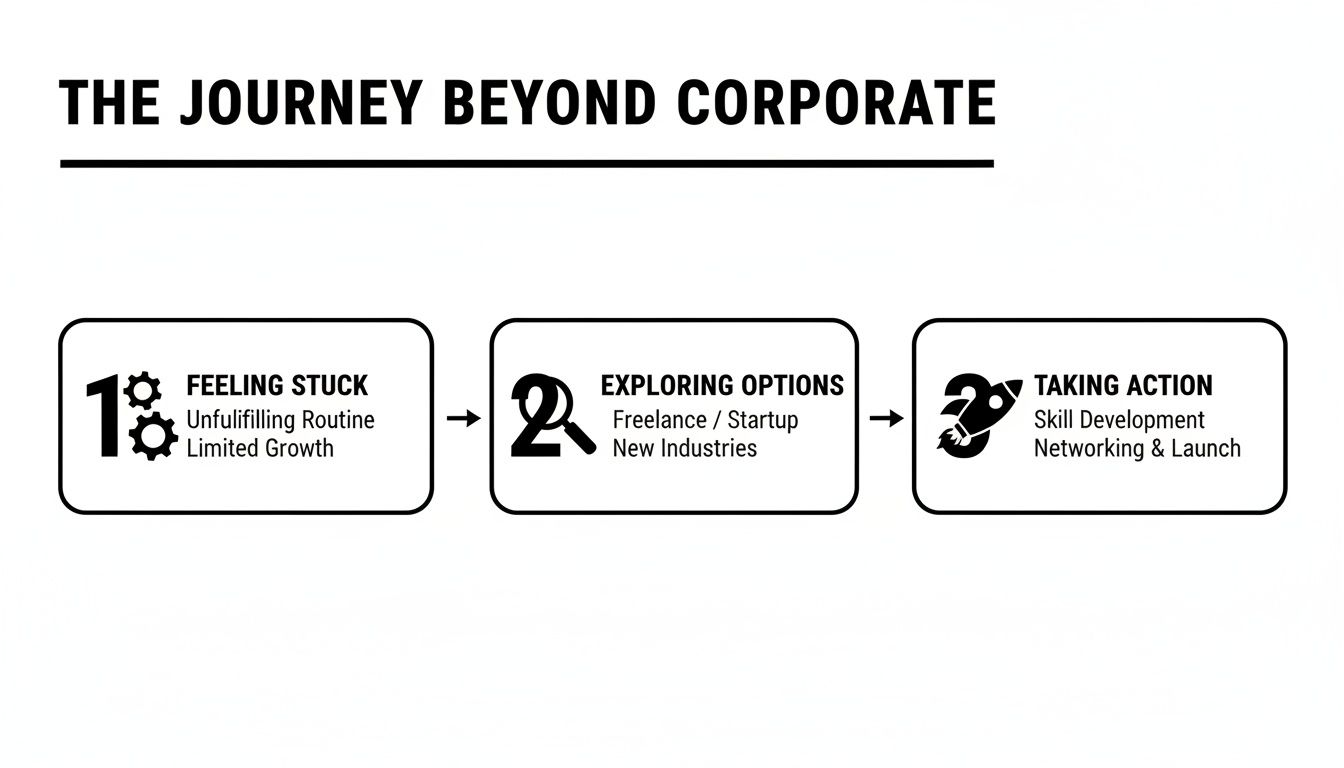
This journey from feeling trapped to building something new always starts with getting your financial house in order.
Calculating Your Freedom Fund Target
Once you have that bare-bones monthly expense number, you can finally put a real target on the wall. How long of a runway do you need? That depends on your personal risk tolerance and how quickly you expect your new venture to start paying the bills.
Most people should aim for 6 to 12 months of living expenses saved up.
Here’s how I think about it:
- A 6-Month Runway (Conservative): This is a solid start. It gives you a decent buffer to get things rolling without feeling like you're up against the clock from day one.
- A 12-Month Runway (Ideal): This is the sweet spot. A full year gives you precious time to test ideas, pivot if needed, and grow your business without the constant, nagging worry of your savings running dry.
- An 18+ Month Runway (Aggressive): If your business idea is in a more volatile space or you just have a lower appetite for risk, a longer runway provides maximum security and total peace of mind.
This simple table helps you visualize what your specific savings goal looks like based on your monthly expenses.
Your Freedom Fund Savings Target
This table helps you calculate how much you need to save based on your monthly expenses and desired runway length.
| Monthly Expenses | 6-Month Runway (Conservative) | 12-Month Runway (Ideal) | 18-Month Runway (Aggressive) |
|---|---|---|---|
| $3,000 | $18,000 | $36,000 | $54,000 |
| $4,500 | $27,000 | $54,000 | $81,000 |
| $6,000 | $36,000 | $72,000 | $108,000 |
So, if your bare-bones number is $4,500 a month, your ideal 12-month Freedom Fund target is $54,000. Seeing that specific number makes it a real, tangible goal you can start working toward today.
Quitting your job is a financial decision just as much as it is a career one. Think of your savings as your parachute—you need to pack it correctly before you jump out of the plane.
How to Hit Your Savings Goal Faster
Reaching a big savings target while you're still at your 9-to-5 calls for a deliberate strategy.
First, go to war with high-interest debt, especially credit cards. This kind of debt is an anchor, actively pulling you away from your goal. Make paying it off your absolute top priority.
Next, put your savings on autopilot. The day you get paid, have an automatic transfer send a set amount from your checking to a separate high-yield savings account. This "pay yourself first" strategy is hands-down the most effective way to build your fund consistently.
And if you ever doubt your own value, just consider what your departure means for your employer. It costs a company, on average, 33% of an employee's annual salary to replace them. For someone making $50,000 a year, that's a $16,500 hit to the company's bottom line. This isn't just a fun fact; it's a powerful reminder of your worth, especially when 66% of HR leaders say retention is their biggest challenge. You can dig into more of these workforce retention trends if you're curious.
At the end of the day, building this runway is about buying yourself two of the most valuable assets you can have: time and freedom. It's the ultimate investment in yourself, turning a pipe dream of leaving your job into a well-thought-out, actionable plan.
Validate Your Business Idea While Still Employed

So, you've got your Freedom Fund goal on a spreadsheet. Fantastic. But the next move isn't to start a countdown clock to your last day. The smartest entrepreneurs do something far more critical: they prove their business has a pulse while the corporate paycheck is still funding the mission.
This whole phase is about running cheap, high-learning experiments. The goal? To confirm that real, living-and-breathing humans will actually pay for what you plan to do. It’s one thing to think you have a million-dollar idea; it’s another thing entirely to get a stranger to pull out their credit card.
Validation is what turns a dream into a viable business.
Start with Low-Risk Business Models
You don't need to invent the next big thing or build a complex SaaS product from scratch to break free. The quickest path to validation is by picking a proven model that doesn't demand a massive upfront investment.
Here are a few a great starting points:
- Freelancing or Consulting: This is the purest form of validation there is. You take the skills your employer already pays you for—marketing, coding, design, project management—and sell them directly to your own clients. There's no inventory, no overhead, just your brain and your expertise.
- A Productized Service: This is the next level up from freelancing. You package a specific service into a fixed-scope, fixed-price offer. Instead of just "web design," you offer "A Five-Page WordPress Website for Therapists for $2,500." It’s so much easier to market and sell.
- E-commerce (Dropshipping): Got a product idea? Before you fill your garage with inventory, test it with dropshipping. A third-party supplier handles all the stock and shipping, so your only job is to nail the marketing and customer service.
- Digital Products: Think ebooks, templates, workshops, or mini-courses. These have incredible profit margins and can even be pre-sold to validate demand before you've created the final product.
The name of the game is speed to revenue. Choose a path that gets you to your first dollar as quickly and cheaply as possible. This isn't about building a legacy brand just yet; it's about proving the core concept works.
Your First Client Is Your First Proof Point
Landing that first paying client is a huge moment. It's the ultimate silencer for that little voice of doubt in your head, providing concrete, undeniable proof that your idea has value in the real world.
For anyone starting a service business, platforms like Upwork or Fiverr are brilliant testing grounds. Don't get hung up on the platform's reputation; your goal isn’t to build a six-figure agency overnight. It's simply to find one person willing to pay you for a specific task.
Let's say you're a corporate marketer dreaming of a freelance SEO business. Here’s what a validation test could look like:
- Set up a super-focused profile on Upwork, highlighting your SEO skills for a specific niche, like "SEO for Local Plumbers."
- Bid on five small, relevant projects—maybe a one-off blog post optimization or a keyword research task.
- Your only mission is to get hired for one of them, even if it's just for $100.
That first $100 is worth more than months of business planning. It’s real-world evidence. It's the first critical step on your journey of how to leave a corporate job with a solid plan B.
A business plan is just a hypothesis. A paying customer is a fact. Your job is to collect facts, not perfect the hypothesis.
Validating a Product with Minimal Investment
But what if you want to sell a physical product? The principle is identical: prove people want it before you sink a ton of money into it.
Imagine you want to launch an online store selling high-quality, ethically sourced coffee beans. Instead of buying thousands of dollars in inventory upfront, you could run a simple test:
- Build a Simple Landing Page: Use a tool like Carrd or Leadpages to create a one-page site that showcases your future product. Use great photos and compelling copy that explains what makes your coffee special.
- Drive Some Targeted Traffic: Spend $50-$100 on targeted Facebook or Instagram ads aimed at coffee lovers in your city.
- Measure Intent with a "Pre-Order" Button: This is the key. Your button won't take payments. Instead, it will lead to a simple form where you collect email addresses, explaining you’re launching soon and they'll be the first to know.
Success here isn't measured in dollars, but in email sign-ups. If 10% of the people who visit your page are interested enough to hand over their email, that's a powerful signal that you're onto something. You've just built your first waitlist of potential customers.
Define Your "Escape Velocity" Number
Validation isn't a one-and-done thing. It's about building momentum. As you land more clients or get more pre-orders, you need a clear, non-negotiable benchmark that tells you when it’s actually safe to make the leap.
I call this your "Escape Velocity."
This is the specific, consistent monthly income from your side business that gives you the green light to hand in your notice.
This number should be directly tied to the "bare bones" monthly budget you figured out earlier. A solid, conservative target for most people is when your side hustle consistently generates 50% of your essential monthly expenses for at least three consecutive months.
For example, if your essential monthly spend is $4,000, your Escape Velocity target would be $2,000 per month. Hitting that for three months straight proves two things: your business model is sustainable, and you have enough traction to realistically replace your full salary once you go all-in.
Untangling the Legal Red Tape of Your Exit
Your finances are in order and your side hustle is showing real promise. It's an exciting time, and it’s easy to get caught up in planning your bright new future. But before you fire off that resignation email, there's some critical, not-so-glamorous work to do: dealing with your legal and contractual obligations.
Trust me, ignoring the fine print in your employment contract is the fastest way to turn a clean break into a legal quagmire. You want to make sure nothing from your old job can come back to haunt you once you're out the door.
Time to Read Your Employment Contract (For Real This Time)
Remember that thick packet of papers you signed on your first day? Dig it out. It’s time to actually read it, specifically looking for clauses that could throw a wrench in your plans. Think of it as one last bit of due diligence before you fully leap into your new venture.
Here are the big three you need to hunt for:
- Non-Compete Clause: This is the one everyone worries about. It’s a clause that might try to stop you from working for a competitor or launching a similar business for a certain amount of time in a specific area. Their enforceability varies wildly from state to state, but you absolutely have to know if you signed one.
- Non-Solicitation Clause: This one is a little different. It’s designed to stop you from poaching your old company’s clients or trying to hire away your former colleagues. These are often easier for companies to enforce, so get clear on its scope.
- Intellectual Property (IP) Agreement: Pay close attention here, especially if your new business is even remotely related to your old job. Many agreements state that anything you created using company time or resources belongs to them. Yep, that can sometimes include ideas you had on your own time if they relate to the company's business.
A Word of Advice: Don't just gloss over these. If the legal jargon is dense or you think there's a potential conflict, spend the money for a one-hour chat with an employment lawyer. That small investment can save you a world of hurt later on.
Sorting Out Your Benefits Transition
When you leave a corporate gig, you instantly become your own Head of HR. The first two things you'll need to tackle are your health insurance and retirement savings.
For health insurance, you've got a couple of main options. You can opt for COBRA, which lets you keep your old health plan for up to 18 months. The catch? You're now paying 100% of the premium plus a fee. It’s usually pricey, but it means no disruption in your coverage, which can be a huge relief.
The other path is to shop for a plan on the public health insurance marketplace.
A site like HealthCare.gov lets you compare plans side-by-side. The best part is you might qualify for subsidies based on your new, and likely lower, founder's income.
As for your 401(k), the smartest move is usually to initiate a rollover into an IRA (Individual Retirement Account). This gives you way more control and often comes with lower fees. You can leave it with your old employer, but consolidating your money where you can manage it is generally the way to go.
And don't forget about any vested stock options! You typically have a short window—often just 90 days—after you leave to exercise them. You need a plan before you quit. Decide if you'll exercise and hold, or exercise and sell for a final injection of cash into your startup fund.
Making a Graceful and Professional Exit

Alright, your business idea is validated and your finances are locked in. Now for the delicate part: actually quitting your job. How you leave is just as important as why you’re leaving. Trust me, the professional world is smaller than you think, and the last thing you want to do is burn bridges on your way out.
Think of this as the final chapter of your corporate story—you want to end it with class. It all starts with a direct, face-to-face conversation with your manager. Schedule a private meeting, take a deep breath, and be ready to state your intentions clearly and calmly.
Right after that chat, you'll want to follow up with a formal resignation letter. This isn't the place to air grievances or write a novel about your reasons. Keep it short, sweet, and professional.
What to Include in Your Resignation Letter
Your written notice is really just for the record books. It needs to be concise and hit a few key points, and that's it.
- The Clear Part: Get straight to the point. State that you're resigning and mention your final day of employment.
- A Touch of Gratitude: A simple "thank you for the opportunity" goes a long way. If you can mention a specific skill you learned or a positive experience, even better.
- An Offer to Help: Reassure them you're committed to making the transition as smooth as possible during your last two weeks.
And… that's it. Keep it simple and positive. This letter will likely live in your HR file forever, so make sure it paints you in a good light.
Prepping for the Big Conversation
That face-to-face meeting can feel pretty intimidating. Your manager could be surprised, disappointed, or they might even hit you with a counteroffer to try and keep you. You need to walk in ready for anything.
Be prepared for questions about what you're doing next. You’re under no obligation to spill all the details about your new business. A polite, slightly vague response is your best friend here.
"I'm not quite ready to share the specifics, but I'm really excited to pursue a new path that's more aligned with my long-term goals. For now, my main focus is making sure we have a seamless handover here."
This response is respectful but firm, and it cleverly shifts the focus back to a productive transition. If a counteroffer comes up, just remember why you decided to leave in the first place. If your heart is set on entrepreneurship, a bigger salary isn't going to change that.
It can also help to remember that people leave jobs all the time. It's a normal part of business. Some industries, like travel and hospitality, see regular turnover rates around 2.8%. In other fields, like supply chain, companies are bracing for 20% to 25% turnover because of labor shortages. You can dig into more employee turnover survey data if you're curious, but the point is, your departure isn't a crisis—it's business as usual.
Your ultimate goal is to make your final weeks as positive and productive as possible. Leave them with a great final impression.
Thriving in Your First 90 Days of Freedom
So you did it. You actually walked away from the corporate world. Take a deep breath. That wild mix of pure exhilaration and sheer panic you're feeling? Totally normal. This is your first taste of freedom, and the next 90 days are a strange, wonderful, and sometimes bumpy ride. You're not just starting a business; you're building a whole new life.
The biggest jolt to the system usually isn't the work itself. It's the silence. It's the sudden, gaping hole where a rigid structure used to be. No more 9 AM stand-ups, no manager setting your priorities, no water-cooler gossip. This new, wide-open space can feel less like freedom and more like a void. Your very first mission is to build a routine that actually works for you, not some faceless corporation.
Designing Your New Normal
Whatever you do, don't just try to copy-paste your old 9-to-5 schedule into your home office. That's a rookie mistake. Instead, start listening to your own rhythm. Maybe your brain is on fire in the morning, making it the perfect time for deep client work. You could block out 9 AM to noon for just that, then take a long break for a walk or the gym before tackling emails and admin for an hour in the late afternoon.
This isn't about slacking off; it's about working smarter. The point is to create a structure that keeps you from burning out while making sure you're focused on the things that will actually grow your new business. Without a schedule you set for yourself, the days will melt into one another, leaving you wondering where the time went and what you actually accomplished.
The nuts and bolts of building a business—sending invoices, marketing, doing the work—that’s the easy part. The real challenge is wrestling with the mental gremlins that will pop up. Your new routine is your best defense against them.
To stay sane and see real progress, you need clear, bite-sized goals for this 90-day sprint. Forget about building a million-dollar empire right now. Instead, focus on small wins that create momentum and prove you're on the right track.
Here are a few examples of what solid 90-day goals might look like:
- Land your first 3 paying clients.
- Hit $1,500 in monthly recurring revenue (MRR).
- Get 250 people to sign up for your email list.
These small victories are everything. They are the tangible proof you'll cling to when self-doubt inevitably whispers in your ear. They're the fuel that reminds you this crazy leap was the right move.
Find Your People and Celebrate Every Single Win
Let's be honest: this path can be incredibly lonely. You’ve just unplugged from a built-in social network, and your friends with "real jobs" won't always get what you're going through. You have to be intentional about finding your tribe.
Look for a mastermind group, hop into virtual meetups for founders in your space, or connect with others who have made a similar leap. Building a support system isn't a "nice-to-have"—it's a must. These are the people you'll turn to for real-world advice, a kick in the pants when you need it, and a high-five when you succeed.
And on that note, get into the habit of celebrating. Signed that first contract? Go out for a nice lunch. Finished a brutal project? Take the rest of the afternoon off. Acknowledging these milestones, no matter how small, is what will keep your spirits up for the long haul.
We Get It: The Big Questions Haunting Your Escape Plan
Thinking about leaving your corporate job feels like standing on the edge of a diving board. It’s exciting, but also terrifying. You’ve probably got a million questions swirling around in your head. It’s totally normal. Let's tackle the big ones we hear all the time.
How Do I Really Know if I'm Financially Ready to Quit?
It’s not just about a gut feeling. You’re truly ready when you can check off three specific boxes. First, you've stamped out all your high-interest debt. I’m talking about credit card balances and personal loans that act like an anchor on your finances.
Second, your "Freedom Fund" is locked and loaded. This means you have at least 6-12 months of essential living expenses saved up in cash. This isn't just a nice-to-have; it's your non-negotiable safety net that lets you sleep at night.
And finally, your side business is bringing in real, consistent money—enough to cover at least half of your monthly bills. Hitting these marks takes the pressure off, giving you the runway to grow your new venture without the constant stress of financial panic.
What if My Side Hustle Completely Flops After I Quit?
This is the fear that keeps people stuck. But let's reframe this. It's not "failure," it's a "pivot point." Every skill you're learning right now—pitching clients, running marketing campaigns, managing projects—is making you more valuable, period.
Your financial runway is designed for this exact scenario. It gives you plenty of time to tweak your business, launch a different offer, or even land a much better remote job than the one you left. Seriously, many companies love hiring people with entrepreneurial experience. It shows you’ve got grit, initiative, and understand how a business actually works. You're a stronger candidate after trying than you were before.
The real failure isn't a business that doesn't pan out. The real failure is letting the fear of that happening stop you from ever taking the shot. You're building skills for life, not just for one business idea.
How on Earth Do I Juggle a Full-Time Job and a Side Hustle?
Let's be honest: it’s tough. It forces you to get absolutely ruthless with your time. A great first step is to track your time for a week. You’ll be shocked at where the hours go. Cut out the low-value stuff like scrolling through social media or watching shows you don't even care about.
Next, start time-blocking. Schedule non-negotiable slots for your business every week, even if it's just an hour here and there. You’d be amazed what 5-10 highly focused hours a week can accomplish over time.
Most importantly, focus only on the tasks that make you money. Don't get bogged down designing the perfect logo or obsessing over business cards. Spend that precious time talking to potential customers and closing your first few sales. It’s a short-term grind, but it’s the only thing that will fuel your long-term dream of finally walking away from that corporate job.
At Remotepreneur, we provide the playbooks, founder stories, and community support to help you build a thriving remote business from anywhere. Start exploring your path to freedom today.
