

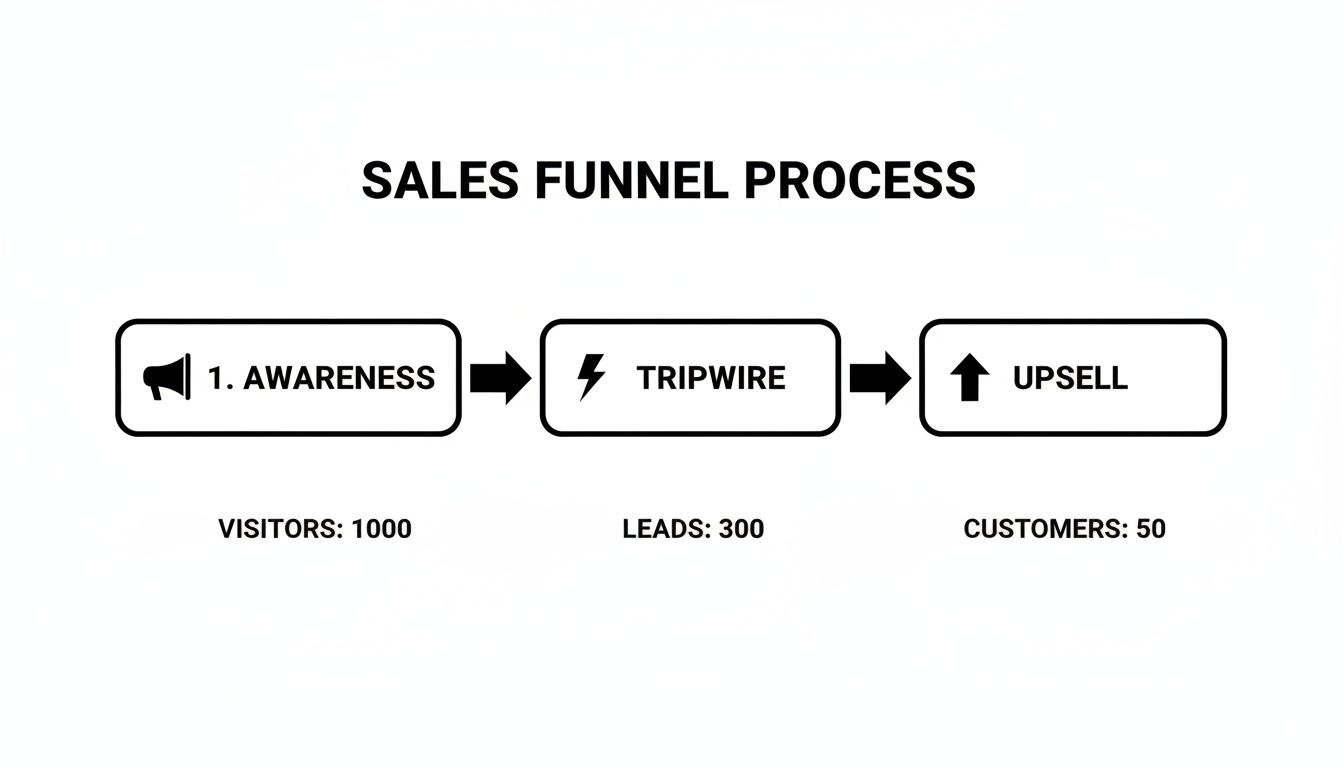
Need a rapid blueprint to map out a sales funnel that drives revenue for remote-first teams? Start by defining five core stages—Awareness, Lead Magnet, Tripwire, Core Offer and Upsell—and tie a specific KPI to each.
Quick Roadmap For Sales Funnel Creation
Balancing simplicity with depth is crucial for remote-first businesses. Every touchpoint should guide prospects closer to a purchase, matching their mindset with the right content.
- Awareness: Pull in prospects through SEO, social ads and guest contributions.
- Lead Magnet: Deliver a focused freebie that solves one small, urgent problem.
- Tripwire: Introduce a low-cost, high-value product (under $20) to turn interest into trust.
- Core Offer: Pitch your main solution, tackling a significant pain point head-on.
- Upsell: Suggest add-ons or service bundles at checkout to boost average order value.
This flow builds momentum and gently nudges leads toward a decision.
Overview Of Funnel Stages And Metrics
Here’s a snapshot of each phase with its goal, primary metric and typical conversion benchmarks.
| Stage | Goal | Key Metric | Average Conversion Rate |
|---|---|---|---|
| Awareness | Reach | Impressions | ~2.35% |
| Lead Magnet | Opt-Ins | Email Signups | 15–30% |
| Tripwire | Mini Sale | Purchase Rate | 5–10% |
| Core Offer | Revenue | Order Rate | 1–3% |
| Upsell | AOV | Upsell Rate | 20–40% |
Putting these figures into practice helps you identify where to test, tweak or scale.
This classic funnel graphic shows how wide-ranging traffic narrows into your highest-value buyers.
On average, funnels convert at 2.35%, yet optimizing each stage can lift deal sizes by 102%. Teams with organized pipelines often see an 18× jump in revenue—dive deeper into funnel statistics on ElectroIQ.
This quick overview sets the stage for more advanced strategies ahead.
Understanding Sales Funnel Stages
To guide prospects toward a purchase, you need to think of your funnel as a journey. Awareness is where you put useful content in front of your audience—whether that’s in LinkedIn groups or niche forums.
One design studio shared daily tips in a Slack community and watched click-through rates soar by 45%.
- LinkedIn articles drive 1200+ new contacts each month by tackling very specific challenges.
- Guest posts on industry blogs position you as an authority before an engaged readership.
- Facebook group sessions spark direct conversations that boost newsletter sign-ups.
Once people notice you, it’s time to reel them in with a magnetic offer.
Lead Magnet Goals
Your Lead Magnet should zero in on one pressing problem and deliver a quick win. A marketing consultant I know created a one-page checklist to diagnose social media bottlenecks—and saw opt-ins rise by 60%.
- Specific outcome: solve a single, painful issue.
- Digestible format: short guide, template or mini-video.
- Instant access: delivered via email or direct download with no hurdles.
These early wins set the stage for your next offer.
Crafting Your Tripwire
Tripwires are low-cost, high-value deals designed to convert curious leads into paying customers. For instance, a coaching platform sold a $7 mini-session and converted 30% of buyers into long-term clients.
- Keep price under $20 for an impulse-friendly entry point.
- Pack in tangible value—a template or lightning-fast audit.
- Hint at the logical next step to ease the upsell into your Core Offer.
Interestingly, across 14 industries the average conversion rate sits at 2.9%, with organic search at 2.7%, paid search at 3.2%, email at 2.6%, and referrals at 2.9%. Explore those benchmarks in this study on Ruler Analytics.
Positioning The Core Offer
After a successful Tripwire, your Core Offer must tackle the main challenge head-on. One remote-first SaaS team ran a simple customer survey to refine its headline—and saw demo requests climb by 40%.
Another consultancy reframed its service as a “Revenue Acceleration Plan,” borrowing client language directly. That tweak boosted purchase rates almost immediately.
A concise message that speaks the customer’s language can increase conversions by 25%.
- Goal: raise lead-to-customer rate above 5%.
- KPI: monitor click-throughs and demo requests per campaign.
- Target: shrink churn by closing messaging gaps in onboarding.
These metrics seal up revenue leaks and deepen your offer’s resonance.
Timing Your Upsells
The sweet spot for upsells is right after a purchase, when trust is high. A SaaS team introduced a three-month advanced support package just 24 hours after onboarding—and lifted lifetime value by 18%.
- Bundle complementary add-ons that extend the core product.
- Offer premium support or training at a special rate.
- Use time-limited discounts to spark urgency without pressure.
Monitoring where prospects drop off between these stages highlights exactly where your timing or messaging needs a tweak.
| Stage | Sample KPI | Remote Example |
|---|---|---|
| Awareness | Impressions | 10k LinkedIn views |
| Lead Magnet | Opt-in rate | 30% via checklist |
| Tripwire | Purchase rate | 25% for $9 audit |
| Core Offer | Demo requests | 12% of tripwire buyers |
| Upsell | Upsell rate | 20% for support plan |
Treat your funnel as a living system: tweak headlines, test CTAs, adjust your schedule, and review every KPI weekly.
Key takeaway Every stage must connect through consistent messaging so prospects feel a natural progression.
- Personalize CTAs with customer names or pain points.
- Automate follow-ups but audit your metrics manually each week.
- Segment early to deliver the most relevant offer.
Combine these elements and you’ve built a robust, scalable funnel tailored for remote-first growth. Monitor drop-offs, iterate every month, and watch your sales engine roar to life.
Design A High Converting Sales Funnel
Begin by choosing an offer that feels just right for your audience’s budget and mindset. Think about a micro-problem you can solve instantly—a quick win that makes them want more.
Brainstorm A High Value Freebie
First, gather actual pain points from surveys or support tickets. Then pick a format that delivers fast results—like a one-page guide or a short video clip.
A remote design agency rolled out a simple three-step checklist and saw opt-ins spike by 45%.
- One-page checklist that fixes a single workflow bottleneck in minutes
- Mini video tutorial teaching one advanced tip in under five minutes
- Interactive quiz diagnosing customer challenges with tailored feedback
Keep it laser-focused. Clear headings promise immediate results, and minimal requirements mean prospects finish it in under ten minutes.
Structure A Compelling Tripwire
Your tripwire is a low-cost offer under $20 that feels like a no-brainer. It’s a taste of the deeper value in your core offer.
A marketing coach introduced a $7 audit and converted 30% of buyers into full-price clients.
- Price below $20 to remove friction and spark impulse buys
- Include a tangible deliverable, such as a template or audit report
- Tease the core offer by previewing advanced results
Track performance closely. Run monthly A/B tests on pricing and value propositions, and send cart reminder emails to rescue abandoned tripwires.
Use Tested Email And Landing Templates
Plug in email sequences that remote startups swear by. In one case, a four-email funnel with punchy subject lines pushed open rates past 50%.
Pair this with a landing page template: bold headline, benefit list, and social proof section.
“Our email series boosted click-throughs by 38% in two weeks,” said a remote founder.
Always test subject lines and page layouts side by side.
- Write concise preview text that highlights a top pain point
- Place a clear CTA button above the fold on every page
Apply Persuasive Copy Techniques
A strong money-back promise eases hesitation. Real testimonials and case numbers build trust. Time-sensitive bonuses or limited spots ramp up urgency—without feeling pushy.
- Risk Reversal: Full refund within 30 days, no questions asked
- Social Proof: Customer success snippets tied to specific results
- Urgency Tactics: Countdown timers or deadline mentions in your copy
Measure lift percentages to see which tactic moves the needle most.
| Technique | Lift |
|---|---|
| Risk Reversal | 15% |
| Social Proof | 20% |
Layer In Natural Next Step Upsells
Right after someone buys, they’re primed for add-ons. Bundle services or premium tiers with clear benefits and pricing. Then segment your list so each subscriber sees the most relevant offer based on their behavior.
| Pricing Model | Segment Trigger |
|---|---|
| Add-on support at $49 monthly | First-time buyers |
| Premium training at $99 per seat | Tripwire purchasers |
Use time-limited discounts on upsells to create urgency.
- Bundle pricing for common add-on combinations
- Follow up with cross-sell emails after the core offer purchase
One remote coaching platform emailed segmented upsells within 48 hours and saw an 18% lift.
Crafting a high-converting funnel comes down to matching offers, copy, and timing with real audience needs. Brainstorm your freebies, nail the tripwire, deploy proven templates, sharpen your copy, and layer upsells. Keep an eye on KPIs—opt-in rate, tripwire purchase rate, upsell lift—and iterate weekly based on real user behavior. Enjoy steady growth and revenue gains.
Set Up Your Sales Funnel Tech Stack
With your blueprint in hand, it’s time to wire up every touchpoint so leads glide through your remote funnel without a hitch. Pair a nimble page builder with an email platform, and you’ll trigger a welcome sequence the moment someone opts in.
Choose Landing Page And Form Tools
Start by testing drag-and-drop builders that let you publish pages and embed forms in minutes.
- Webflow (https://webflow.com) gives you full CSS control and plugs directly into many CRMs.
- Leadpages (https://www.leadpages.com) comes loaded with high-conversion templates and built-in A/B testing.
- Carrd (https://carrd.co) lets you spin up one-page funnels in under ten minutes on a shoestring budget.
Connect Email Automation And Workflows
Next, link your form to an email service so subscribers get instant follow-ups. Use native integrations or a tool like Zapier to connect with platforms such as ConvertKit (https://convertkit.com) or MailerLite (https://www.mailerlite.com).
- Create a dedicated list in your ESP to track funnel sign-ups.
- Map form fields to tags or custom fields in your email tool.
- Submit your own form to confirm the lead magnet lands in the inbox right away.
“A streamlined email workflow can boost open rates by over 50%, ensuring leads get the right information at the right time.”
Sync CRM And Chat Tools
Your CRM handles lead scoring and sales handoffs, so choose a system that fits your team’s style. Try HubSpot (https://www.hubspot.com), Pipedrive (https://www.pipedrive.com) or Salesforce (https://www.salesforce.com) to automate deal stages and notifications.
- Tag new leads to ping your account manager in Slack.
- Auto-move deals to “Demo” when someone books through Calendly.
- Score prospects by form source or engagement for easy qualification.
Don’t skip adding a Facebook or Google retargeting pixel on your pages to re-engage visitors who haven’t converted.
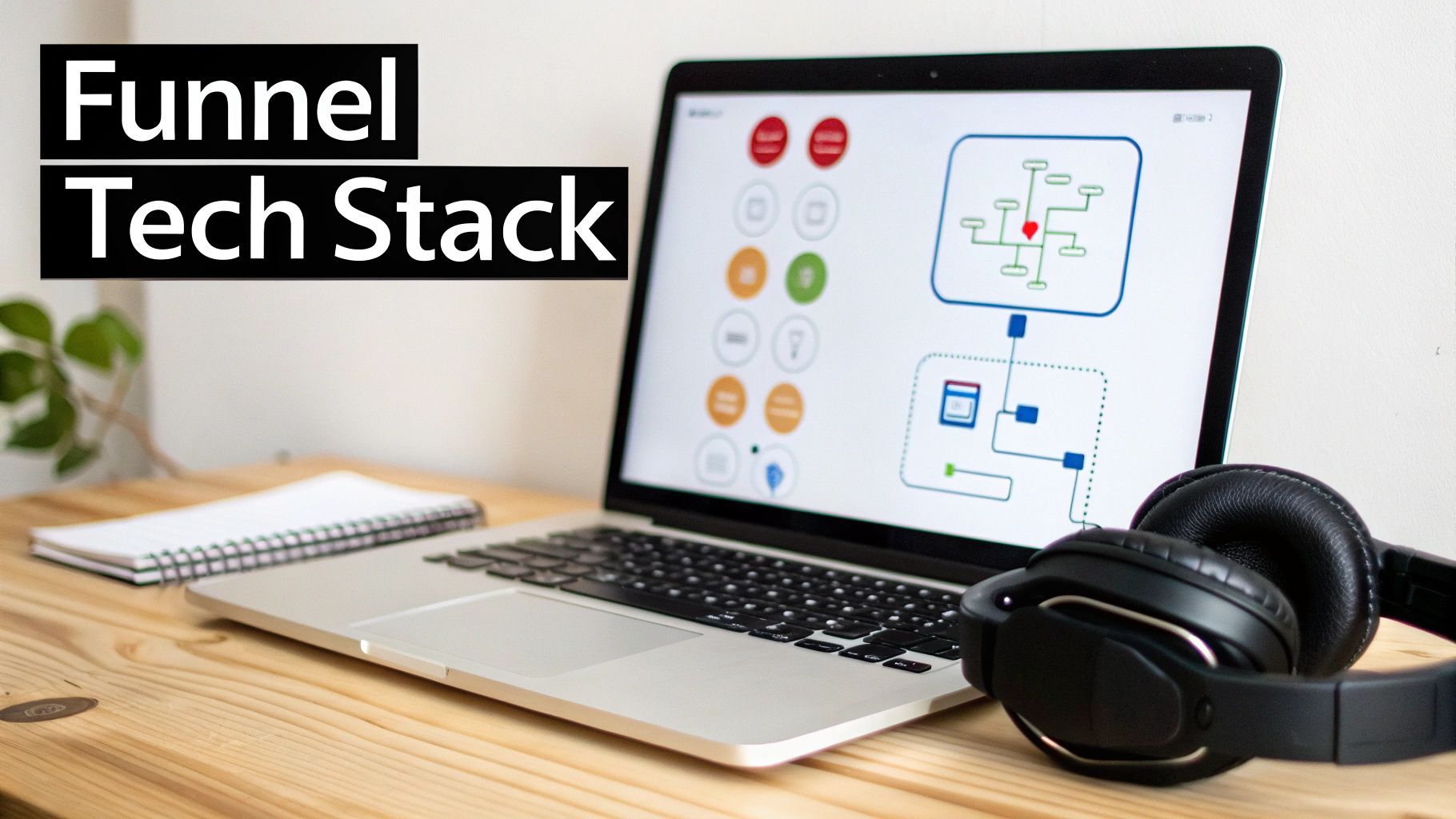
Adoption spikes for email sequences and CRM workflows, showing that 73% of users rely on these core automations.
Sales calls sit at the bottom of your funnel and deliver 13–25% conversion rates, though results vary by industry and lead source. Referrals tend to convert at 25.56%, while cold calls hover around 9.38%, so prioritize lead qualification first.
Learn more about sales call conversion rates on focus-digital.
Implement Retargeting And AI Personalization
A few lines of code drops your retargeting pixel into headers or footers in minutes. Then turn on dynamic copy to swap headlines or CTAs based on visitor behavior.
- Use [first name] tokens in email subject lines to boost open rates.
- Display location-based offers—click-throughs can jump 120%.
- A/B test AI-generated headlines to find what resonates best.
Finish with a quick audit of every integration to catch any broken links or missing tags.
Tech Stack Integration Checklist
- Verify form-to-ESP triggers and tag mappings.
- Confirm CRM pipelines progress on actions like demo bookings.
- Test your retargeting pixel with a browser extension.
- Review Zapier flows for chatbots, calendar invites, and notifications.
- Check AI content swaps on landing pages and emails.
- Monitor all metrics on a single dashboard with real-time alerts.
This checklist keeps your funnel humming without manual interventions.
With these systems in place, your team can focus on nurturing relationships and closing deals instead of juggling notifications.
Compare Zap Tools For Your Team
| Tool | Integrations | Strengths | Pricing Model |
|---|---|---|---|
| Zapier | 3000+ apps | Intuitive builder | Task-based tiers |
| Make | Visual canvas | Complex logic and data mapping | Usage-based |
| Pabbly | Unlimited flows | Flat monthly fee | Budget-friendly |
Choose the right tool by balancing budget, complexity and support. Run live scenarios, log errors, and schedule monthly reviews. Keep every API key and credential in a secure vault so your remote team can access what they need—instantly.
Happy automating!
Test And Optimize Your Sales Funnel
Launching your funnel is exciting, but it’s just the starting line. Real growth kicks in when you let data guide your tweaks.
- Experiment with headlines, button text, page layouts, and email sequences.
- Measure lift percentages so you know which changes really move the needle.
- Reengage nearly 70% of abandoners through smart retargeting flows.
- Bring dormant leads back to life with tested email reactivation sequences.
Designing A/B Tests That Move The Needle
A/B testing uncovers what resonates. Picture this: you swap two headlines, split your audience evenly, and watch which one sparks more clicks.
- Define a crystal-clear hypothesis before you launch.
- Keep each variation running until you hit at least 100 conversions.
- Compare conversion rates side by side to calculate your lift.
Retargeting And Reactivation Strategies
Lost prospects can still convert if you catch them at the right moment. Meanwhile, reactivation emails often revive up to 40% of sleepers on your list.
- Segment users by recent behavior to keep messages relevant.
- Drop in dynamic tokens for a personal touch in both ads and emails.
- Fine-tune ad frequency—stay top of mind without feeling pushy.
Optimization Checklist For Your Funnel
Small technical wins add up fast. A few seconds shaved off load times and crisp mobile layouts make visitors stick around.
- Ensure main pages load in under 2 seconds.
- Confirm responsive design across all devices and browsers.
- Test every personalization token to avoid awkward blanks.
- Audit analytics tags and pixel fires for accurate tracking.
Case Studies Of Incremental Gains
A bootstrapped ecommerce brand tweaked button colors and saw conversions jump 35%. Another team played with subject lines, lifting open rates from 18% to 28%.
Key Takeaway Treat optimization like your morning coffee—an essential ritual that builds momentum.
Carve out a weekly slot to review results, celebrate even modest wins, and map out fresh ideas.
Testing Email Sequence Variations
Finding the right cadence can feel like a puzzle. Does a three-email series outperform five? Are questions in subject lines more inviting than statements?
- Compare a shorter versus longer nurture path.
- Swap question-style lines with straight-ahead statements.
- Mix formats—tips, mini case studies, or personal stories—to keep content fresh.
Advanced Page Layout Experiments
A tiny shift in design can redirect your visitor’s gaze. That single change might be the difference between a scroll and a click.
- Compare a hero video against a static image for immediate engagement.
- Replace traditional bullet lists with icons and bite-sized paragraphs for faster scanning.
- Test sticky header CTAs versus buttons embedded in the copy.
Personalization And Dynamic Content
The more personal, the better. A headline that mentions someone’s city or a first-name token in preview text feels like a one-on-one conversation.
- Insert first-name tokens in headlines and preview snippets.
- Surface geo-targeted offers or testimonials from nearby customers.
- Use countdown timers set to the visitor’s time zone for genuine urgency.
Tracking And Reporting Metrics
A central dashboard keeps everyone on the same page. When you spot anomalies fast, you can act fast.
- Flag any conversion drop greater than 10% within 24 hours.
- Distribute weekly reports highlighting key wins and areas that need attention.
- Annotate analytics when tests begin and end to keep context clear.
Regular reporting turns data into shared insights. Post results in your team channel, recognize a 2% lift in conversions, and decide together if it’s time for new variations. Embrace this cycle of small, steady improvements and watch how a data-driven approach fuels your remote-first growth.
Practical Tips For Funnel Success
When you zero in on just one pain point, your message hits home every time. A laser-focused approach resonates far better than broad, catch-all statements.
With this clarity, you naturally guide prospects through every stage of the funnel—no guesswork required. Meanwhile, automating routine emails (think welcome sequences or thank-you page cross-sells) frees you up to focus on higher-touch moments.
That said, don’t let tech do all the heavy lifting. Block out time each week for personal outreach to your most promising leads. Building that human connection boosts trust and underlines your brand’s authenticity.
- Always include a thank-you page after opt-ins or purchases
- Segment new leads by behavior to send tailored offers
- Schedule personal calls or customized emails for top prospects
By weaving these tactics into your daily workflow, every interaction feels intentional. You’ll see steady lifts in conversion rates and happier customers who feel genuinely cared for.
Test with real user data. Adjust based on performance feedback. Keep the cycle tight.
Common Pitfalls To Avoid
Overstuffing your funnel with upsells can leave prospects feeling pressured.
Skipping mobile optimization? You might lose up to 60% of your visitors.
Ignoring segmentation turns your offers into one-size-fits-none pitches.
Focus on quality over quantity in every funnel element
And don’t overlook the basics: track core KPIs from day one. Metrics like opt-in rate, tripwire purchase rate, and upsell conversion are your roadmap for quick, informed tweaks.
Do’s And Don’ts
Do
- Personalize CTAs based on your segments
- Automate routine tasks but review key metrics weekly
- Keep copy concise and directly tied to customer pain points
Don’t
- Blast every subscriber with the same generic offer
- Add upsells without clearly stating the benefit
- Overlook bounce rates or slow-loading pages
Mini Launch Checklist
- Review your messaging to ensure it targets a single problem at each stage
- Confirm automation workflows and thank-you pages are firing correctly
- Segment contacts so offers feel relevant and timely
- Test your entire funnel on both mobile and desktop devices
- Set up dashboards tracking opt-in, tripwire, core offer, and upsell performance
Kick off your test within 24 hours, then watch your metrics like a hawk. Iterate quickly, celebrate the small victories, and keep refining. That’s how you build a funnel that not only converts but grows with your business.
FAQ
This section answers the biggest questions remote-first teams have about building a sales funnel.
You’ll find practical tips on budgets, timelines, audience tweaks, and the KPIs that matter most.
Planning Your Funnel Budget
Wondering how much you need to launch? Expect to invest both time and money upfront. Budget around $500–$1,000 for ads, $50–$100 per month on tools, plus roughly 10–15 hours of setup.
- Ad Spend: Reserve $200–$500 for initial tests on social or search
- Tool Costs: Plan $50–$100 monthly for a page builder, email service, and CRM
- Time Investment: Allocate 10 hours to build landing pages and automate sequences
- Buffer: Add 10% extra to cover surprise costs
Pro Tip
Keeping a buffer on your ad spend lets you explore different channels without breaking the bank.
These estimates help you launch confidently and avoid early leaks in your funnel.
Timeline For Funnel Optimization
So, when will you see meaningful results? Early signals surface in week one. By the end of month one, you should notice clear improvements. Quarter one is when the ROI story really starts to shine.
- Week One: Monitor opt-in rates and cost per lead
- Month One: Target a 5–10% boost in CTR and a 15% drop in CPL
- Quarter One: Aim for a 1–2% uptick in overall conversion rate and a higher AOV
This phased plan keeps expectations realistic and lets you celebrate each win.
Adapting Funnels For B2B And B2C
Yes, you can run one core funnel for both B2B and B2C—just swap out the messaging and offers. I’ve seen SaaS teams swap enterprise case studies for flash-sale banners, and form fills jumped by 22%.
| Audience | Messaging Focus | Typical Offer | Example ROI |
|---|---|---|---|
| B2B | ROI and Case Studies | Free Demo | 12% demo-to-trial conversion rate |
| B2C | Instant Benefits and Proof | Discount Coupon | 8% purchase rate after opt-in |
Essential Funnel Metrics
Focus on the KPIs that tell you exactly what’s working—and what needs fixing. Track cost per lead, tripwire conversions, core offer purchases, and average order value.
- Awareness: Impressions and click-through rate
- Lead Magnet: Opt-in rate
- Tripwire: Purchase rate
- Core Offer: Conversion rate on your main product
- Upsell: Attachment rate on additional offers
Key Takeaway
Regularly reviewing these metrics reveals where to double down and where to tweak.
Weekly or biweekly reports keep everyone aligned and let you pivot fast.
Iteration And Reporting
Keep the team in the loop with short, focused reviews. When everyone sees real-time data, ideas spark and fixes happen faster.
- Book a 15-minute weekly funnel standup
- Share a live dashboard highlighting drop-off points and wins
- Assign ownership for each stage to speed up improvements
Enjoy building and refining your remote-first funnel.
Elevate your funnel game with Remotepreneur. Discover proven playbooks and real examples to grow your remote-first venture: Remotepreneur
