
So, you're thinking about starting an ecommerce business. Good. You've come to the right place.
Getting started really comes down to three big moves: figuring out if your idea can actually make money, picking a business model that fits your budget and lifestyle (like dropshipping or creating your own brand), and then building an online store that people actually want to buy from.
This isn't just theory. This is a practical, step-by-step guide to take you from a spark of an idea to a real, operational business that you can run from anywhere.
Your Blueprint for a Successful Online Store
Think of this as your launch checklist. We're going to start by pressure-testing your business idea to make sure it's more than just a passion project—it needs to be profitable. Then, we’ll get into the nuts and bolts of different business models, with real-world examples to help you figure out which one makes sense for you.
The opportunity here is massive. Seriously. Global retail ecommerce sales are on track to hit $6.42 trillion in 2025, which is a huge slice (20.5%) of all retail spending worldwide.
With over 2.77 billion people shopping online, the customers are there. The trick is cutting through the noise of the 28 million other ecommerce stores. Success isn't just about having a website; it’s about finding your niche and making it your own. If you want to get a better handle on the market, you can dig into these ecommerce trends and see what they mean for a new founder like you.
It all follows a pretty straightforward path when you break it down.
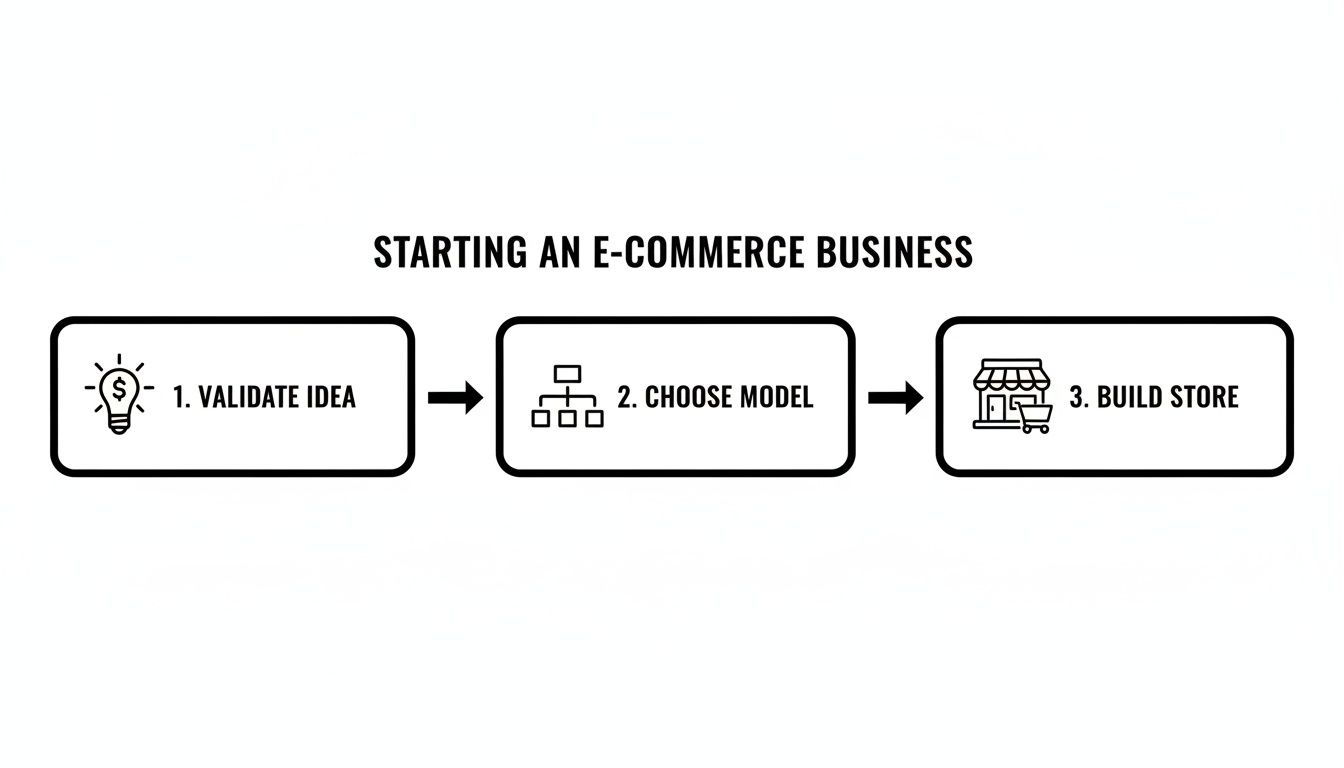
This isn't about getting lucky. It's about following a clear progression: start with a solid concept, choose the right operational model, and then build your store.
Choosing Your Ecommerce Business Model
One of the first forks in the road is deciding on your business model. This decision will shape everything—your startup costs, how you spend your days, and your profit margins. Let’s look at the big three.
Here's a quick comparison of the most common ecommerce business models to help you decide which path is right for your new venture.
Ecommerce Business Model Comparison
| Business Model | Upfront Cost | Inventory Management | Best For |
|---|---|---|---|
| Manufacturing | High | You handle everything | Unique, innovative products with high brand control. |
| Dropshipping | Very Low | None (supplier handles it) | Beginners, testing ideas, and wide product catalogs. |
| Private Label | Moderate | You manage branded stock | Creating a brand without product R&D from scratch. |
Each of these models has its place. The key is to pick the one that aligns with your resources and long-term goals.
The Big Three Models Explained
-
Manufacturing: This is the most hands-on approach. You design and create your own unique products from scratch. You get total control over quality and branding, but it also means a much bigger upfront investment in product development, holding inventory, and all the logistics that come with it.
-
Dropshipping: Probably the most popular entry point. You team up with a supplier who stocks the inventory and ships products directly to your customers when an order comes in. It’s incredibly low-cost and low-risk, making it perfect for beginners. The trade-off? Thinner profit margins and less control over the shipping and unboxing experience.
-
Private Labeling: This is a fantastic middle-ground. You find a product that’s already being made, and you work with the manufacturer to put your own brand name and packaging on it. You get a branded product without the headache of inventing something from the ground up.
"Your business model is the foundation of your entire operation. Choosing the right one aligns your financial risk, operational capacity, and brand ambitions from day one. Don't chase trends; pick the model that fits your personal strengths and resources."
For instance, if you're passionate about sustainable fashion, you might choose to manufacture a small run of eco-friendly t-shirts. On the other hand, if you want to test a dozen different product ideas without going broke, you'd start by dropshipping home goods. Or, you could find a popular fitness accessory, private label it with your own slick branding, and build a marketing machine around it.
There's no single "best" path—only the one that's right for you.
Finding Your Niche and Sourcing Products

Every great ecommerce business starts with the right product in the right niche. This is the foundation that separates the stores that take off from the ones that never get off the ground. The magic isn't just about finding something you're passionate about; it's about finding where your passion, audience demand, and real profitability all meet.
Forget trying to be the next Amazon. The real opportunity is in thinking smaller and more focused. You want to serve a specific community with a product they can't easily find anywhere else.
Validating Your Big Idea
Before you ever spend a dime on inventory, you have to prove your idea has legs. Is there a real, breathing audience that actually wants what you plan to sell?
Start with a tool like Google Trends. Let's say you're thinking about minimalist leather wallets. You can use Trends to see if search interest is growing, flat, or dying off. Even better, you can compare it to related ideas, like "RFID-blocking wallets" or "slim cardholders," to see which corner of the market has the most buzz.
Next, you need to go where your potential customers hang out. Dive into Reddit, search hashtags on Instagram, and see what's trending on TikTok. Look for dedicated communities. What are people asking for? What are their biggest complaints about the products they already own? This is pure gold. You might stumble into a rock-climbing subreddit and find a dozen people complaining that their chalk bags always spill—that's a clear signal for a product opportunity.
A classic rookie mistake is falling in love with a product idea before confirming anyone else loves it, too. Your validation process needs to be brutally honest. Let the data—search trends, social chatter, and competitor weak spots—tell you if you’ve got a business or just a hobby.
Finally, you need to size up the competition. Find three to five stores already in your niche. What are they doing well? More importantly, where are they dropping the ball? Read their customer reviews, especially the bad ones. Those one-star reviews are your roadmap for creating a better product or a far superior customer experience.
Choosing Your Product Sourcing Method
Okay, so you have a validated idea. Now, how do you actually get your hands on the products? This is a huge decision. There are three main paths, and each comes with its own set of pros and cons.
1. Working Directly with a Manufacturer
This is the path to total control. You’re creating a unique product from scratch, dictating everything from the materials to the final design. It’s the best way to build a one-of-a-kind brand, but it also demands the biggest upfront investment in R&D, minimum order quantities (MOQs), and inventory.
2. Dropshipping
Dropshipping is the easiest on-ramp to ecommerce. You find a supplier who stocks the inventory and ships products directly to your customers whenever an order comes in. Your job is all marketing and sales. The startup costs are next to nothing, but you give up control over quality and shipping times, and the profit margins are notoriously thin.
3. Private Labeling
Think of this as the happy medium. You find a great generic product made by a third-party manufacturer and put your own brand name and packaging on it. This lets you build a brand identity without the massive cost and time of creating a product from scratch. You’ll still need to buy inventory, but you get to skip the long product development cycle.
Vetting Suppliers and Calculating Profitability
No matter which path you take, vetting your suppliers is non-negotiable. Don't skip this. Always order samples to check the quality for yourself. See how responsive they are to your emails. Get firm answers on production lead times and shipping costs.
Before you sign anything, you have to run the numbers. Calculate your landed cost—that's the total cost to get a single unit into your hands, including the manufacturing, shipping, and any import duties. Then, figure out what you can realistically sell it for. The gap between your landed cost and your selling price is your profit margin, and it will tell you everything you need to know about whether this business can actually make money.
The ecommerce world is massive, with just the online marketplaces generating an estimated $428.3 billion in the U.S. in 2024. While giants like Amazon get all the headlines, data shows there's plenty of room for niche players to build a profitable business. As you can see from the growth of online marketplaces here, a focused, well-sourced product can absolutely find its audience and thrive.
Alright, let's get that storefront built. This isn't just about slapping some products online; it's about creating your digital headquarters—the place where window shoppers turn into loyal customers.
Think of your ecommerce site as your best salesperson. It works 24/7, tells your brand story, and handles the register. Getting this part right from the get-go is probably one of the most important things you’ll do.
The great news is, you don't need a computer science degree to build a beautiful, functional store anymore. Modern platforms have made it incredibly simple, but picking the right one for you is a big decision that’ll shape how you run your business every day.
Picking Your Ecommerce Platform
So, where should you build this thing? Your choice really comes down to three things: how comfortable you are with tech, your budget, and where you see this business going in a few years.
Here’s the rundown on the big players:
-
Shopify: This is the go-to for most people starting out, and for good reason. It’s an all-in-one package that's ridiculously easy to use. They handle all the nerdy server stuff, have a massive App Store to add any feature you can dream of, and their support is top-notch. You just pay a monthly fee and focus on selling.
-
BigCommerce: A major competitor to Shopify, BigCommerce's main draw is that it comes with more features baked right in. This can save you money on paid apps down the road. It’s a real powerhouse, especially if you have a ton of products or plan on growing aggressively.
-
WooCommerce: If you’re familiar with WordPress, this might be your jam. WooCommerce is a free plugin that bolts a full-featured store onto your WordPress site. The trade-off? You’re on the hook for your own web hosting, security, and updates. It gives you ultimate control but demands a bit more technical skill.
Top-tier platforms like BigCommerce don’t just give you the tools; they also provide a ton of resources to help you succeed, from in-depth guides to industry reports.
This is a great example of how the best platforms are invested in your growth, offering a lot more than just a place to list your products.
Designing a Store That Actually Sells
Once you've picked your home base, it's time to decorate. But we're not just making it look pretty; we're designing an experience that smoothly guides visitors from "just browsing" to "order confirmed." This whole game is called conversion rate optimization (CRO).
It all starts with your product pages. Please, don't just list specs. Sell the feeling. Show off your products with stunning, professional photos from every conceivable angle. If you can swing it, a short video showing the product in use is pure gold.
Your product description isn't just a label—it's your silent sales pitch. It has to anticipate a customer's questions, paint a vivid picture of how this item will make their life better, and squash any doubts they might have.
And you absolutely, positively need social proof. Get a reviews app installed from day one and make it a habit to ask every single customer for feedback. A product with 25 genuine, positive reviews will outsell a product with zero reviews every time. It’s not even a fair fight.
Nailing the Checkout Process
This is it. The final step. The moment of truth. And sadly, it's where so many businesses fumble the ball. You did all that work to get someone to click "Add to Cart," only for them to vanish.
The numbers are pretty scary: a mind-boggling 70.19% of online shopping carts are abandoned. That stat alone should tell you how critical a frictionless checkout is. You can dig into more of the data on why people leave without buying here.
To fight back against cart abandonment, you have to eliminate every little annoyance.
- Let Them Check Out as a Guest: Seriously, don't force people to create an account. It's one of the fastest ways to lose a sale.
- No Surprise Costs: Be upfront about shipping, taxes, and any other fees. Nothing makes a customer bolt faster than an unexpected charge on the final screen.
- Offer Plenty of Payment Options: At a bare minimum, take all the major credit cards. But you should also have trusted options like PayPal, Apple Pay, and Google Pay. The more ways you let people pay, the fewer excuses they have to leave.
Finally, make sure all your behind-the-scenes tech is talking to each other. Connect your payment processor (like Stripe or Shopify Payments) and double-check that your shipping settings are calculating rates correctly. A smooth checkout experience on the front end is only as good as the reliable, professional operation backing it up.
Crafting Your Go-To-Market Launch Strategy
You’ve built a beautiful online store. That’s a huge milestone, but right now, it’s a digital ghost town. If nobody knows it exists, it can't make any sales.
This is where we pivot from building to broadcasting. It’s time to map out your go-to-market launch strategy—a concrete plan to grab the attention of those all-important first customers and prove your business has legs. Forget a "one-size-fits-all" playbook. A powerful launch blends quick wins with long-term growth channels, creating both immediate buzz and a foundation for the future.

Build Your Audience Before You Even Launch
The best product launches I've ever seen started weeks, sometimes months, before the "open for business" sign went up. Your goal here is simple: build a waiting list of people who are genuinely excited to buy from you. This isn't just about creating hype; it’s about validating that people actually want what you're selling.
Your best friend in this pre-launch phase is a simple "coming soon" landing page. It doesn't need to be complicated, but it absolutely must have:
- A killer headline that nails your unique value proposition.
- Gorgeous, high-quality photos or mockups of your product.
- A can't-miss call-to-action to sign up for an exclusive launch-day discount.
Once that page is live, share it everywhere you can think of. Post it on your personal social media, share it in relevant online communities, and tell your friends. If you have a small budget, consider running a handful of targeted ads to your ideal customer profile, driving them straight to your sign-up form. Every single email you collect is a potential day-one sale.
Your Launch Marketing Mix
When launch day arrives, it’s time to make some noise. Your strategy should hit potential customers from a few different angles simultaneously. Think of this as a starting recipe—you can and should tweak it based on your budget, niche, and where your audience hangs out.
1. Paid Social Ads for Immediate Impact
Want to get in front of the right people, fast? Facebook and Instagram ads are your ticket. You don't need a massive budget to start. Create a few different ads showcasing your product in a real-world setting and point them directly to your product pages.
Your goal here isn't immediate profit. It's data. You're paying to learn what ad copy works, which images grab attention, and what audience actually clicks "buy."
2. Organic Content for Long-Term Trust
While ads bring in that initial traffic spike, great content is what builds a lasting brand. Start a blog, a TikTok account, or a YouTube channel focused on genuinely helping your target audience.
Selling high-performance running shoes? Create content about marathon training plans, injury prevention stretches, or the best pre-race nutrition. This simple shift positions you as a trusted expert, not just another person trying to sell something. This is the bedrock of your long-term SEO strategy, and it will draw in free, qualified traffic for years.
3. Influencer Marketing for Authentic Reach
Look for micro-influencers in your space—these are creators with smaller but highly dedicated followings. An endorsement from them often feels more like a real recommendation from a friend than a slick, corporate ad. You don’t need to break the bank; many will be happy to work with a new brand in exchange for free products.
A classic launch mistake is spreading yourself too thin. Don't try to be on every single platform. Pick two or three channels where you know your ideal customer spends their time and go deep. Master those first, then expand.
Mobile and Social Commerce are Non-Negotiable
Let’s be clear: your entire launch strategy has to be built for how people actually shop today. That means on their phones and often directly within social media apps.
Mobile commerce is an absolute juggernaut, pulling in $2.51 trillion in sales and accounting for a massive 59% of all online retail. On top of that, social commerce adds another $1.17 trillion. The message couldn't be clearer. Your website, your ads, and every piece of content must look and work flawlessly on a small screen. Dig into more insights on the rise of mobile and social shopping on SellersCommerce to truly grasp how critical this is.
Set a Realistic Budget and Define Success
You don’t need a Fortune 500 marketing budget to have a successful launch. What you do need is a realistic one. Figure out what you can comfortably spend in your first 30 days and stick to it.
Just as important is deciding what "success" actually looks like. Spoiler: it probably isn't a six-figure revenue number on day one. Your real goals should be about momentum and learning. For example:
- Make your first 50 sales.
- Get 10 positive customer reviews.
- Build an email list of 1,000 engaged subscribers.
These early metrics give you the proof, feedback, and confidence you need to refine your strategy for the next phase. Your launch isn't the finish line—it’s the starting gun. It’s all about getting your product into the hands of real people and learning from their experience to fuel your growth.
Keeping the Engine Running: Operations for Sustainable Growth

That first sale notification? It's an incredible feeling. But a successful launch is just the beginning. The real, gritty work of building a business that lasts happens behind the scenes in your operations.
This is the engine room. It’s how you get orders out the door, keep customers happy, and manage your money. Nailing these processes early on is what separates the brands that fizzle out from the ones that are still here years from now.
From Your Garage to a Global Warehouse
So, how are you going to get products into your customers' hands? In the early days, almost every founder I know starts by doing it themselves.
Handling your own fulfillment is the best way to learn the ropes. You’ll be the one packing every box and printing every label, giving you a deep, firsthand understanding of your product and what your customer unboxes. It’s cheap, and you have complete control over quality.
But as the orders pile up, packing boxes can easily become your entire day. That’s your cue to think about outsourcing. A third-party logistics (3PL) partner is a warehouse that stores your inventory, then picks, packs, and ships orders for you.
There's a reason this is such a common move. In fact, a whopping 60% of retailers outsource at least some of their fulfillment, with 20% handing it over completely. That speaks volumes about how crucial these partnerships are for scaling. You can dig into more stats about the growing fulfillment services market on Capital One Shopping.
Building a Customer Service Machine
Never underestimate the power of great customer service—it’s your secret weapon for retention. A happy customer might tell a friend, but an unhappy one will broadcast their frustration to the world. The trick is building a system that’s efficient for you and feels genuinely helpful to them.
Start simple. Create a dedicated support email and draft a few canned responses for the questions you'll get over and over:
- Where’s my order?
- What’s your return policy?
- Can you tell me more about [product feature]?
These templates will save you hours and keep your messaging consistent. Once you're handling more volume, you can level up with help desk software like Gorgias or Zendesk to keep conversations organized.
Your goal isn't just to solve problems; it's to turn a potentially negative experience into a positive one. A quick, empathetic, and helpful response can transform a frustrated customer into a lifelong brand advocate.
Mastering the Financial and Legal Stuff
Don't let the numbers and legal jargon scare you. Getting a few basics right from day one will save you a world of pain down the road.
First up, your business structure. Most new ecommerce founders begin as a sole proprietorship because it’s dead simple. But forming an LLC (Limited Liability Company) is a smart next step, as it protects your personal assets if the business ever gets into trouble.
Next, and this is non-negotiable: open a separate business bank account. Mixing personal and business finances is a recipe for a bookkeeping nightmare. Use a simple accounting tool like QuickBooks or Xero to keep track of every dollar in and out. This isn't just for tax season—it's how you know if you're actually profitable.
Key Metrics Every Founder Must Watch
You can't grow what you don't measure. While you could drown in data, focusing on a handful of key numbers will tell you almost everything you need to know about the health of your business.
These are the essential Key Performance Indicators (KPIs) you should be looking at every week.
Key Ecommerce Metrics to Track for Growth
Here's a breakdown of the essential Key Performance Indicators (KPIs) you need to monitor to understand the health and potential of your online business.
| Metric (KPI) | What It Measures | Why It's Important |
|---|---|---|
| Customer Acquisition Cost (CAC) | The average cost to get a new customer (e.g., ad spend / new customers). | Tells you if your marketing is profitable and efficient. |
| Customer Lifetime Value (LTV) | The total revenue you can expect from a single customer over time. | Helps you decide how much you can afford to spend on CAC. The goal is LTV > CAC. |
| Conversion Rate | The percentage of website visitors who make a purchase. | Shows how effective your website and product pages are at turning browsers into buyers. |
| Average Order Value (AOV) | The average amount a customer spends in a single transaction. | Increasing your AOV is a powerful way to boost revenue without needing more traffic. |
Tracking these numbers gives you a real-time dashboard for your store's performance, helping you make smarter decisions instead of just guessing what's working.
Common Questions About Starting an Ecommerce Business
Jumping into ecommerce is exciting, but it’s completely normal to have a long list of questions swirling around in your head. It’s easy to get bogged down by the "what ifs" and never actually get started. Let's tackle some of the biggest, most common questions I hear from new founders so you can move forward with confidence.
We're going to clear the air on those nagging doubts and give you the straight answers you need.
How Much Does It Really Cost to Start?
This is the big one, and the honest answer is: it really depends on the path you choose. You definitely don’t need a five-figure bank loan to get your store off the ground.
You could launch a dropshipping or print-on-demand store for under $100. Seriously. Your main expenses will be your ecommerce platform subscription (like a basic plan on Shopify), a domain name, and maybe a couple of crucial apps. Since you’re not buying any inventory upfront, the initial cash outlay is incredibly low.
Now, if you're going the private label or custom manufacturing route, your startup costs will be higher. You have to buy your products before you can sell them. A typical first inventory run can cost anywhere from $1,000 to $5,000, which depends on how complex your product is and what the manufacturer's minimum order quantity (MOQ) is.
My advice? Always start lean. Get a minimal viable product out there with a small inventory order. The goal isn't to have a perfectly stocked warehouse from day one; it's to prove your concept and get those first sales without betting the farm.
Do I Need a Formal Business Plan?
Forget the 50-page, binder-ready document you’re picturing. For a new ecommerce store, you don't need that kind of old-school business plan unless you're trying to get a traditional bank loan.
What you absolutely need is a simple, one-page action plan. Think of it as a blueprint for yourself. It should quickly outline:
- Your Niche: Who are you selling to? What problem are you actually solving for them?
- Your Product: What makes your product special or a better choice than what's already out there?
- Your Sourcing Method: Are you dropshipping, using a private label supplier, or manufacturing from scratch?
- Your Launch Marketing: How are you going to get your first 50 customers? Be specific.
- Your Basic Numbers: A quick sketch of your startup costs, how much each product costs you, and your target selling price.
This isn't for investors—it’s a roadmap for you. It forces you to think through the most critical parts of your business and gives you a clear direction to follow.
What Legal Structure Should I Choose?
The moment you start selling, you're technically a sole proprietorship. It’s the default, simplest structure with zero paperwork, but there’s a catch: there's no legal separation between you and the business. Your personal assets are the business's assets.
As soon as you start making consistent sales, it's a smart move to form a Limited Liability Company (LLC). An LLC creates a legal wall between your business and your personal life. This means if something goes wrong—say, the business takes on debt or faces a lawsuit—your personal assets like your house and savings are shielded.
Setting one up is usually a pretty straightforward process. You can often do it online through your state's Secretary of State website or use a service like LegalZoom to handle the paperwork for you.
How Long Until I Make a Profit?
Patience is probably the most underrated skill in ecommerce. While you hear stories about founders hitting it big with a viral product overnight, the reality for most of us is that it takes time to find your footing.
Realistically, expect it to take anywhere from 6 to 12 months before your store is consistently in the black.
In the early days, you'll likely be reinvesting every dollar you make right back into the business—testing new ad campaigns, creating content, and maybe ordering more inventory. That initial phase is all about learning, gathering data, and iterating, not necessarily taking home a big paycheck.
But the opportunity is massive. With global ecommerce sales projected to hit $7.4 trillion in 2025, the potential market is almost hard to comprehend. According to these online retail statistics and trends, capturing even a tiny piece of that pie can lead to an incredibly successful business. The key is to manage your own expectations and focus on building something sustainable.
Ready to turn your idea into a real, remote-first business? Remotepreneur provides the playbooks, founder stories, and step-by-step guides you need to build and scale your venture from anywhere. Discover your path to a profitable remote business today.
