
Let's be real: your dropshipping store is only as good as your suppliers. You could have the slickest website and the most brilliant marketing, but if your partner can't ship quality products on time, you're toast. Finding the right supplier isn't just a box to check—it’s about building a real partnership that can make or break your business.
So, where do you even start? The best approach is to cast a wide net. I've found that relying on just one source, like a single directory, is a mistake. You'll want to explore a mix of supplier directories, direct outreach to manufacturers, and some smart online searching to build a solid list of potential partners.
Your Starting Point for Finding Great Dropshipping Suppliers
Before you dive headfirst into Google, take a step back and think about what you actually need. A supplier that’s a rockstar for a US-based electronics store probably isn’t the right fit for a European fashion boutique. Things like warehouse location, shipping speed, and whether they specialize in your niche are crucial from the get-go.
Align Your Search With Your Business Needs
To avoid wasting time on suppliers that are a bad match, ask yourself a few key questions:
- Where are my customers? This is non-negotiable. If you're selling to an American audience, you need a supplier with warehouses in North America. End of story.
- What’s my niche? A specialized supplier will almost always have better products and more expertise than a massive, generalist marketplace.
- What quality level am I aiming for? Are you competing on price, or are you building a premium brand? Your answer will immediately narrow your search.
It also helps to understand the bigger picture. The global dropshipping market was valued at around $365.7 billion in 2024 and is expected to blow past $476 billion by 2026. That explosive growth is a double-edged sword: more supplier options are popping up, but so are the duds. With North America and Asia-Pacific holding most of the market share, filtering by region is a smart first move to manage shipping times and costs. If you want to dive deeper into the numbers, Printful.com has some great dropshipping market statistics that can help shape your strategy.
I like to think of the whole discovery journey in three simple phases:
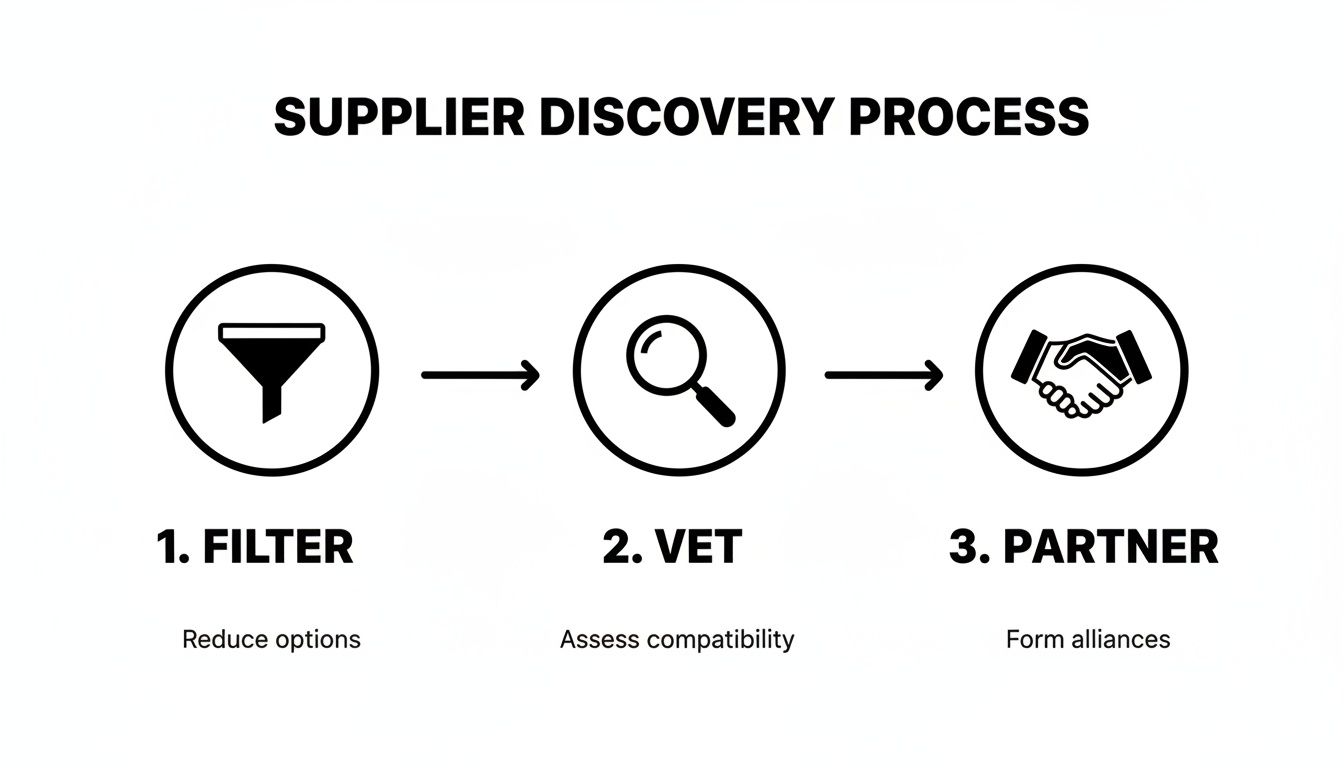
Think of it as a funnel. You start with a big list, do your homework to weed out the weak links, and then lock in a partnership with the best of the best.
Here's a quick rundown of the main channels you'll be using to find those potential partners.
Top Supplier Sourcing Methods At a Glance
This table breaks down the most common ways to find suppliers, so you can see which one might be the best starting point for your store.
| Sourcing Method | Best For | Key Advantage | Potential Drawback |
|---|---|---|---|
| Supplier Marketplaces | Beginners and those wanting fast integration. | Easy to search, filter, and connect with suppliers. | High competition and potentially lower profit margins. |
| Supplier Directories | Entrepreneurs who want to vet multiple options. | Large, curated lists of pre-screened suppliers. | Can be overwhelming; some require a membership fee. |
| Direct Manufacturer Outreach | Niche stores and those seeking unique products. | Better pricing and exclusive product access. | More effort required; many manufacturers don't dropship. |
| Targeted Online Searches | Finding specialized or hard-to-find suppliers. | Uncovers hidden gems not listed in major directories. | Time-consuming and requires careful vetting. |
Each method has its place, and you'll likely find yourself using a combination of them. Start with a marketplace for speed, but keep an eye out for unique manufacturers you can contact directly as you grow.
Finding Your Partners: How to Navigate Supplier Directories and Marketplaces
Alright, this is where the rubber meets the road. Finding the right supplier isn't about aimlessly scrolling through massive sites like AliExpress; it's about having a plan. Think of these platforms as goldmines—you need the right tools and techniques to find the good stuff efficiently.
You’ve got two main places to look. First, there are supplier directories like SaleHoo or Worldwide Brands. These are like curated phone books of pre-vetted partners. You'll usually pay a membership fee, but it saves you a ton of time by weeding out the scams and low-quality operators from the get-go.
Then you have the massive marketplaces like AliExpress or CJDropshipping. These are wide-open ecosystems where pretty much anyone can set up a shop. They're fantastic for discovering new product ideas and getting a sense of the market, but they require a lot more vetting on your part. A smart strategy is to use both—marketplaces for discovery, directories for a layer of trust.
Master the Filters (This is Your Secret Weapon)
Your very first move should be to get surgically precise with the platform’s search filters. This is genuinely the fastest way to cut through the noise. Don't just type "men's watches" and hope for the best. You have to get more granular.
Here are the filters I always use to build my initial shortlist:
- Warehouse Location: This is a deal-breaker. If you're selling to customers in the US, filter for suppliers with warehouses right there in North America. This one simple click can slash shipping times from weeks down to just a few days.
- Shipping Method: Look for reliable, trackable options. Think ePacket for some international routes or established carriers for domestic shipping. If a supplier only offers slow, untrackable mail, just move on.
- Seller Rating/Score: I won’t even look at a supplier with less than a 95% positive feedback score. And don't just look at the score; look at their history. An established seller with a 97% rating over 5 years is far less risky than a brand-new seller with a temporary 100% score.
- Response Rate: A high response rate (I aim for over 90%) is a great sign. It tells you they’re actually engaged with their business and will likely be there for you when you need help.
Using these filters will take a list of thousands and shrink it down to a manageable list of a few dozen. This alone will save you from a world of headaches.
How to Read a Supplier’s Profile Like a Pro
Once you have that shortlist, it's time to put on your detective hat. A supplier’s profile page tells a story, and your job is to read between the lines. Look past the shiny product photos.
Here's what to zero in on:
- Business History: How long have they been around? Longevity is a good indicator of reliability. A supplier with a five-year track record has probably worked out most of the kinks in their process.
- Product Specialization: Do they focus on a specific niche, like outdoor gear, or are they selling a random garage sale of products? A specialist is far more likely to have deep product knowledge and access to higher-quality goods.
- Customer Reviews: Don't just glance at the star rating. Dig in and read the reviews, especially the negative ones. Are people consistently complaining about slow shipping, broken items, or terrible communication? Look for patterns.
A single bad review could just be a fluke. But a recurring theme of "item never arrived" or "broke after one use" is a massive red flag. This is direct feedback from other entrepreneurs just like you—listen to it.
The data supports using a blended approach. While a platform like AliExpress is a go-to for many, research shows that about one in four merchants also use curated supplier directories or apps to lower their risk. It's a smart workflow: find interesting products on the big marketplaces, then see if you can validate the supplier's credibility on a more specialized directory. If you want to dive deeper into how other store owners find their partners, you can check out these detailed dropshipping statistics from Analyzify.
Test Their Communication Before You Commit
Before you even think about placing a sample order, send a simple message. Your goal here isn't just to get an answer; it's to gauge their professionalism. Ask a specific question about a product—maybe about its material or if they can provide a different photo angle.
Here’s what you’re looking for in their reply:
- Speed: Did they get back to you within 24-48 hours?
- Clarity: Was the response clear, professional, and written in decent English?
- Helpfulness: Did they actually answer your question, or did you get a vague, copy-pasted response?
A supplier who gives you a one-word answer or takes a week to respond is showing you exactly how they'll handle your business (and your customers) when a real issue comes up. Trust that first impression. It rarely lies.
The Art of Vetting Potential Suppliers
Alright, you've got a list of potential suppliers. That was the easy part. Now comes the real work—the part that protects your brand, your money, and your sanity. You need to dig in and figure out who the reliable partners are and who will just cause you endless headaches down the line.
Think of it this way: this supplier is a direct extension of your business. Their mistakes? They become your mistakes. Their wins? They fuel your growth. It's a true partnership, and you owe it to your business to do some serious due diligence before you commit.
Spotting the Red Flags Early
You can often spot trouble before you even send a single email. Your gut feeling is a surprisingly powerful tool here. If a supplier's website or profile feels a bit off, it probably is.
Here are a few immediate red flags that should make you pause:
- Vague Communication: If you can't get a straight answer about their shipping process or return policy, just walk away. Transparency is absolutely non-negotiable.
- No Clear Return Policy: Any legitimate supplier will have a clear, easy-to-find policy for returns and damaged goods. If it’s missing or intentionally confusing, that’s a huge problem waiting to happen.
- Negative Online Chatter: Do a quick Google search for "[Supplier Name] + reviews" or "[Supplier Name] + scam." A few grumpy customers are normal for any business, but a consistent pattern of complaints is a clear sign to steer clear.
These initial checks can save you hours by weeding out the obvious duds right from the start.
To make this easier, think of it in terms of red flags and green flags. A quick mental checklist can help you instantly categorize a potential partner.
Here’s a simple table to guide you:
Supplier Vetting Checklist Red Flags vs Green Flags
| Vetting Area | Green Flag (Positive Sign) | Red Flag (Warning Sign) |
|---|---|---|
| Communication | Quick, clear, and professional responses. | Vague answers, slow response times, or evasiveness. |
| Website & Tech | Modern, professional website. Offers data feeds or an API. | Outdated site, broken links, no automation options. |
| Policies | Clear, fair, and easy-to-find return & shipping policies. | No return policy, or policies that are confusing and unfair. |
| Reputation | Positive online reviews and industry presence. | Multiple negative reviews, scam alerts, or no online presence. |
| Product Info | High-quality images and detailed product descriptions. | Low-resolution images, sparse or copied descriptions. |
Using a simple framework like this helps you stay objective and make sure you're not missing anything critical in the heat of the moment.
Your Essential Supplier Questionnaire
Once a supplier passes that initial sniff test, it’s time to ask some direct questions. You're basically interviewing them for a critical role in your company, so treat it that way.
I have a go-to list of questions I always ask potential partners. Feel free to use it:
- Fulfillment Process: How quickly do you typically process and ship orders once you receive them? Which shipping carriers do you work with?
- Inventory Management: How do you keep inventory levels synced with resellers? Do you offer a real-time API or an automated data feed?
- Business History: How long has your company been in business, and how long have you been specifically offering dropshipping services?
- Customer Support: Will I have a dedicated point of contact? What are your support hours and typical response times?
This isn’t about being difficult—it’s about setting clear expectations from the get-go. A truly professional supplier will appreciate your thoroughness and have no problem giving you detailed answers.
A supplier’s reluctance to answer questions about their process is the biggest red flag of all. Great partners are proud of their operations and happy to show you how they work. Hesitation often means they have something to hide.
Why Ordering Samples is Non-Negotiable
If I could only give you one piece of advice on vetting, this would be it: always, always order samples. I really can't stress this enough.
Photos can be tweaked and product descriptions can be… creative. The only way to truly know what your customers will receive is to hold it in your own hands.
Ordering samples lets you check three critical things at once:
- Product Quality: Does the item actually look and feel like it was described? Is this something you’d be proud to put your name on?
- Packaging: Did it arrive safely in professional packaging? Or was it just tossed in a flimsy mailer with zero protection?
- Real-World Shipping Times: How long did it actually take to get to you? This is the ultimate test of their fulfillment speed.
The small cost of ordering a few samples is a tiny investment in your brand's reputation. It’s the final, and most important, step in the vetting process. This is especially true when you factor in geography. For instance, suppliers in the Asia-Pacific region might have lower product costs but you'll be dealing with much longer shipping times. North American suppliers, on the other hand, usually offer faster delivery.
You have to test this for yourself. In fact, data shows that around 84% of online sellers say that finding a reliable supplier is one of their biggest challenges. Rigorous testing is how you avoid becoming part of that statistic. You can discover more insights about dropshipping challenges on BrandsGateway.com.
Making Contact and Negotiating with Suppliers
Alright, you've done the research and have a solid shortlist of potential suppliers. Now it's time to switch gears from investigator to business partner. This is where you lay the groundwork for a relationship that could make or break your store. Your first email sets the tone for everything, so let's make it count.
Remember, the goal of this first message isn't just to get a price list. It's to signal that you're a serious entrepreneur, not just another hobbyist with a brand-new Shopify login. These suppliers get flooded with inquiries daily, so a professional, concise, and thoughtful email will immediately make you stand out from the noise.
Crafting an Outreach Email That Actually Gets a Response
Your first contact needs to strike the right balance—professional but not robotic, personal but not overly casual. Ditch the generic, copy-pasted templates that scream "I'm mass-emailing 50 other suppliers today." A little personalization goes a long way and shows you've actually done your homework.
Here's a simple framework that's always worked well for me:
- A Clear, Professional Subject Line: Something like "Partnership Inquiry from [Your Store Name]" is direct and professional. No fluff.
- A Quick Introduction: Briefly introduce yourself and your store. Mention your niche and what makes your brand different. This shows you have a clear vision and aren't just throwing things at the wall.
- Show You've Done Your Research: This is my secret weapon. Mention a specific product of theirs you admire or think is a great fit for your audience. This tiny detail proves you're not just spamming their inbox and have a genuine interest.
- State Your Intentions Clearly: Let them know you're looking for a reliable dropshipping partner and are interested in building a long-term relationship.
- Ask a Few Key Questions: Keep it to 3-4 essential questions for now. This isn't the time to hit them with a 20-point questionnaire. Stick to the big stuff, like their dropshipping process, average shipping times to your target country, and how they handle returns.
A classic rookie mistake is asking for discounts right out of the gate. This can be a major turn-off. Focus on building rapport first; you can talk numbers later once you've proven you're a valuable partner.
Professionalism is your currency in these early interactions. A well-written email signals that you are organized, serious, and someone they can trust to represent their products well. It’s the first step in building a mutually beneficial relationship.
Shifting from First Contact to Negotiation
Once a supplier responds and you've got a good conversation going, you can start digging into the details. True negotiation isn't about strong-arming your supplier for every last penny. It’s about finding that sweet spot where both of you win.
A great partnership is built on mutual growth. If you can help them move more products, they'll be far more willing to work with you on creating better terms.
Key Areas to Negotiate (It's Not Just About Price)
Beyond the per-unit cost, there are several levers you can pull to create a better deal. Think creatively about what would give your business an edge and how you can frame it as a win for them, too.
- Tiered Pricing: Instead of asking for a flat discount upfront, try proposing a tiered pricing structure. For instance, "Could we explore a 5% price reduction once my store reaches 100 orders per month?" This rewards actual performance and gives both of you an incentive to grow.
- Payment Terms: Most suppliers want payment upfront, which can be tough on cash flow. Once you've built a solid track record of consistent orders, you can ask about more flexible terms, like net-30, where you pay for inventory on a 30-day cycle.
- Custom Packaging and Invoicing: This is a huge branding opportunity. Ask if they can include a custom packing slip with your logo or even use branded boxes once you hit a certain volume. It's a massive value-add for your customer experience.
- Shipping Options: Dive into the details of their shipping carriers and costs. A supplier might have access to better rates with certain couriers that you can tap into. You could also negotiate for access to premium or expedited shipping options to offer your customers.
To really get traction in these conversations, you need to show them the value you bring to the table. Come prepared with data on your store's traffic, conversion rates, and realistic sales projections.
The more you can position yourself as a valuable sales channel for their products—not just another customer—the more leverage you'll have to build a partnership that truly sets you both up for long-term success.
Integrating and Managing Your Supplier Relationship
Alright, you’ve navigated the tricky waters of finding and vetting a supplier, and you’ve even settled on terms. High five! But now comes the part that turns a good idea into a real, functioning business: connecting your store to their systems.
This is where your partnership moves from a handshake deal to a powerful, automated sales machine. The technical integration is your absolute top priority. Think about it—how will you pull their product catalog, inventory levels, and tracking information into your storefront?
Without a rock-solid system in place, you’ll be drowning in manual data entry, constantly at risk of selling out-of-stock items, and dealing with angry customers. Getting this right from the start builds a foundation you can actually scale.
Choosing Your Product Sync Method
There are a few ways to get your supplier's product information into your online store. Each has its pros and cons, and the best choice really depends on your supplier’s tech-savviness and your own comfort level.
Here are the three most common routes people take:
- Manual CSV Uploads: This is the old-school approach. Your supplier emails you a spreadsheet (a CSV file) with all their product data. You then have to format it and upload it to your ecommerce platform. It's simple enough to get started, but it's incredibly labor-intensive and a recipe for errors. Inventory levels can be outdated within hours.
- Dedicated Apps and Plugins: A much better option. Many suppliers, especially those who work with platforms like Shopify or WooCommerce, have built dedicated apps. These plugins often handle everything automatically—product importing, inventory syncing, and even sending orders straight to the supplier. For anyone just starting, this is a lifesaver.
- API Integration: This is the gold standard for serious dropshippers. An Application Programming Interface (API) lets your store and your supplier's system talk to each other directly and in real-time. That means your inventory is always accurate, and orders get transmitted the second they’re placed.
Your integration method has a massive impact on your store's efficiency. A manual upload might be fine when you have 10 products, but an API connection is what allows you to manage thousands of SKUs without losing your mind.
Building a Bulletproof Daily Workflow
Once the tech is hooked up, your focus shifts to the day-to-day grind. A smooth operational workflow is just as vital as the initial integration. This is all about setting up clear processes so that tiny hiccups don’t snowball into massive, customer-facing disasters.
The key here is proactive communication. Don't wait for a problem to pop up before you figure out how to solve it. Define your entire process from day one.
Establishing Clear Communication Channels
I can’t tell you how many supplier relationships I’ve seen fall apart due to bad communication. You absolutely need to establish a clear and efficient way to talk to your partner. Will you use email? A shared Slack channel? Do they have a specific account manager for you?
Get answers to these questions upfront:
- Primary Point of Contact: Who is your go-to person for everything? Get their name, direct email, and maybe even a phone number for emergencies.
- Expected Response Times: Agree on what’s reasonable. An urgent issue with a customer's order needs a much faster reply than a general question about a new product. A 24-hour response time for standard emails is a good starting point.
- Process for Order Issues: What happens when a package gets lost, shows up damaged, or is sent to the wrong address? Knowing the exact steps to take ahead of time saves you from panicking and helps your customer service team look professional.
Setting Expectations for Order Fulfillment and Returns
Finally, you need a crystal-clear process for the two most critical parts of the customer experience: getting orders out the door and handling returns. Any gray area here will come back to bite you in the form of bad reviews and lost customers.
Work with your supplier to create a shared document or understanding that outlines these key details:
- Order Cutoff Times: What’s the latest you can submit an order for it to ship the same day? This is critical for managing customer expectations on shipping speed.
- Tracking Information: How quickly will you get tracking numbers after an order is fulfilled? Customers live and breathe by those tracking updates.
- Returns Procedure: Map out the entire returns process, step-by-step. Who initiates it? Where does the customer send the package? How are you and the customer refunded?
A supplier who is happy to define these processes with you is a keeper. It shows they understand that your success is their success, and they’re invested in building a smooth, professional operation that works for everyone.
Common Questions About Finding Dropshipping Suppliers
Even with the best playbook in hand, you’re bound to have questions when you start digging for suppliers. It’s totally normal to feel a bit unsure about which path to take. Let’s walk through some of the most common questions that trip up new store owners.
Getting these figured out now will save you a ton of headaches later and help you build your business on solid ground.
Should I Work With One Supplier or Multiple Suppliers?
This is one of the first big strategic decisions you'll make, and honestly, there's no single right answer. It’s all about balancing simplicity against security.
When you're just starting out, my advice is almost always to find one great supplier and stick with them. This keeps things simple. You have one relationship to build, one inventory feed to worry about, and one person to call when something goes wrong. It frees you up to focus on what really matters in the beginning: marketing and making sales.
But, and it's a big but, putting all your eggs in one basket is risky. What happens if that supplier runs out of your best-selling product right in the middle of Black Friday? That’s where a multi-supplier strategy comes in handy as your store grows.
The smartest way to scale is to start with a primary supplier for your main products. Once you've got that relationship humming, bring on a secondary supplier as a backup or to add new, complementary products to your catalog. This gives you a safety net without making your day-to-day operations a nightmare from the get-go.
Working with multiple suppliers has other perks, too:
- Bigger Product Catalog: You can mix and match products from different niche suppliers to create a store that really stands out.
- Faster Shipping: You could use a supplier in the US for your North American customers and one in Europe for EU orders, cutting down delivery times for everyone.
- Better Prices: When suppliers know you have options, you gain a bit of leverage to negotiate better terms down the road.
The trick is to nail your process with one partner first. Once you've got that system down, adding a second or third supplier is a smart growth move, not a logistical headache.
How Do I Handle Long Shipping Times from Overseas?
Ah, the classic dropshipping dilemma. You find amazing products with great margins from suppliers in Asia, but the 15-45 day shipping windows can feel like a deal-breaker. The secret isn't to hide the long shipping times—it's to be brutally honest about them.
Most customers are surprisingly patient, as long as you set their expectations from the very beginning.
Make sure your estimated shipping times are crystal clear and easy to find. Plaster them everywhere:
- On Your Product Pages: A simple note like, "Heads up! Please allow 2-4 weeks for delivery," right next to the "Add to Cart" button works wonders.
- In Your Shipping Policy: Create a detailed page that explains why shipping takes a bit longer and walks them through the process.
- In Order Confirmation Emails: Remind them of the shipping timeline right after they’ve made a purchase.
Besides being transparent, you can also give customers choices. Offer a standard, low-cost (or free) shipping option with the longer wait, but also provide a premium, expedited option for an extra charge. This empowers the customer. Many successful stores start this way and eventually partner with suppliers who have warehouses in their target countries to slash those lead times.
What Is MOQ and Should I Avoid It?
You’re going to see this acronym a lot: MOQ. It stands for Minimum Order Quantity, and it’s the smallest number of units a supplier will sell you in a single purchase.
For a pure dropshipping business, your goal is to find suppliers with no MOQ. That's the whole magic of the model, right? You buy one item at a time, only after your customer has paid you. Platforms like AliExpress and most dedicated dropshipping apps are built around this "zero MOQ" idea.
That said, seeing an MOQ isn't automatically a red flag. It usually just means you're talking to a manufacturer or a traditional wholesaler, not someone set up specifically for dropshipping. This can actually be a good thing—it often means you're closer to the source and can get much better pricing.
So, when would you actually consider a supplier with an MOQ?
- When you’ve found a winning product and you’re ready to buy it in bulk to get faster shipping or better margins.
- If you decide to use a third-party logistics (3PL) service to store and ship products for you.
For anyone just starting out, stick to partners with no MOQ. It keeps your cash in the bank and your risk super low, which is exactly what you want when you're learning the ropes.
At Remotepreneur, we provide real-world guides and founder stories to help you build a successful remote business from anywhere. Check out our resources to move from idea to execution. Find your path at Remotepreneur.
Article created using Outrank
