
Ever wondered how successful remote entrepreneurs build reliable, recurring revenue? The secret often lies in choosing the right subscription model. It's the engine that powers everything from niche SaaS tools to thriving membership communities. But with so many options, finding the right path can feel overwhelming. This guide cuts through the noise.
We're breaking down 7 powerful subscription business model examples, complete with the strategies, tools, and real-world tactics you can use to launch and grow your own location-independent empire. This isn't just a list of names; it’s a deep dive into the specific playbooks used by top-tier platforms that teach and implement subscription strategies. You’ll get a behind-the-scenes look at how they package their offerings, attract loyal customers, and build sustainable income streams.
Inside, we analyze each business, providing screenshots and direct links so you can see the models in action. We'll explore:
- Revenue Breakdowns: How they price their products and services.
- Acquisition & Retention: Specific tactics they use to win and keep customers.
- Tooling & Stacks: The software that powers their operations.
- Actionable Takeaways: Replicable strategies you can apply to your own venture immediately.
Whether you're a coach looking to monetize your expertise, a developer building the next great SaaS, or a creator launching a membership site, these detailed breakdowns will give you the clarity you need. Consider this your roadmap to building a profitable subscription business that works for you, from anywhere in the world. Let’s dive into the examples.
1. Remotepreneur
Remotepreneur stands out as a premier playbook hub for entrepreneurs aiming to build or scale a location-independent business. It moves beyond generic advice, offering a deep, filterable database of real-world case studies complete with revenue breakdowns, timelines, and founding details. This makes it an invaluable research tool for anyone exploring different subscription business model examples and other remote-first ventures.
Instead of just telling you what's possible, Remotepreneur shows you how it's been done by others. You can sift through examples ranging from $5,000/month side hustles to seven-figure operations, finding a path that genuinely aligns with your personal and financial goals.
Strategic Breakdown: A Research-First Approach
What truly distinguishes Remotepreneur is its emphasis on actionable data over abstract theory. The platform is built on the premise that the fastest way to succeed is to model what already works. Its core value lies in its powerful filtering system, which allows users to deconstruct success in a granular, replicable way.
- Business Model Filtering: You can specifically isolate case studies by models like SaaS, ecommerce subscriptions, membership sites, and productized services. This allows for direct comparison and analysis of different recurring revenue strategies.
- Revenue and Niche Specificity: Users can narrow their search by monthly recurring revenue (MRR), industry, and founding date. This helps you find a blueprint that matches your current resources and long-term ambitions.
- Execution-Focused Tools: Beyond inspiration, the site provides tangible resources. This includes curated tool recommendations, AI-powered marketing tactics, and financial calculators to help you plan everything from your pricing to your business runway.
Key Takeaway: Remotepreneur’s strength is its structure as a "reverse-engineering" platform. It provides the raw data and tactical tools needed to build a strategic plan based on proven, real-world success stories rather than guesswork.
How Remotepreneur Implements Its Subscription Model
While much of its content is accessible for free, Remotepreneur utilizes a freemium and membership-based model to create a deeper, more personalized experience for dedicated users.
- Free Tier: A free newsletter delivers fresh remote business ideas and tactics directly to your inbox, acting as a lead magnet and top-of-funnel entry point.
- Membership Features: An optional membership unlocks enhanced functionality. Users can save favorite case studies, manage profiles, and access curated content collections, turning the platform from a simple blog into a personalized research dashboard.
- B2B Revenue Stream: The platform also monetizes its highly targeted audience by offering advertising opportunities to brands and SaaS companies looking to connect with remote-first entrepreneurs.
Actionable Insights for Your Business
Remotepreneur is more than just a list of ideas; it’s a strategic resource. Here’s how you can leverage it effectively:
- Validate Your Niche: Before you build, use the database to see if others have succeeded with a similar idea. Analyze their revenue, timeline, and business model to set realistic expectations.
- Model Your Tech Stack: Check the "Tools Used" section in relevant case studies. This gives you a proven list of software and platforms to build your own operations without costly trial and error.
- Develop Your Content Strategy: The platform's free newsletter is a great example of a content-driven lead magnet. It provides consistent value, builds trust, and gently nudges users toward the premium membership features.
Website: https://www.remotepreneur.co
2. Harvard Business Publishing Education (HBPE)
If you're looking for the academic gold standard in business strategy, Harvard Business Publishing Education (HBPE) is your ultimate resource. While not a subscription service itself, it’s an indispensable library for anyone studying or building subscription business model examples. This platform is where the world's leading business schools and corporate training programs get their case studies, articles, and simulations.

Think of it as the source code for modern business education. Here, you can deep-dive into detailed analyses of how giants like Netflix, Adobe, and even niche SaaS companies built their recurring revenue empires. It’s an essential tool for entrepreneurs who want to learn from rigorously researched, real-world scenarios instead of just surface-level blog posts.
Strategic Deep-Dive: Why HBPE is a Must-Use Resource
What makes HBPE so valuable is its unparalleled depth. The case studies aren't just success stories; they are comprehensive breakdowns of strategy, financials, marketing tactics, and operational challenges. You get access to the same materials that MBA students at top-tier universities use to dissect business models.
Here’s why it earned its spot on our list:
- Unmatched Detail: Each case study provides a behind-the-scenes look at a company's journey, often including proprietary data and executive insights you won't find anywhere else.
- Actionable Frameworks: You'll find cases on pricing strategies, customer retention loops, churn reduction tactics, and scaling subscription operations.
- Diverse Examples: The catalog covers everything from SaaS and media subscriptions to consumer goods and D2C brands, offering a broad perspective on the subscription economy.
Getting the Most Out of HBPE
Accessing the content is straightforward. Educators can create a free account to browse the full catalog and access teaching notes. For individual entrepreneurs and professionals, purchasing single cases is the most common route.
Key Takeaway: Use the HBPE search function to find case studies directly related to your niche. Search for terms like "SaaS pricing," "membership retention," or "D2C subscription box" to uncover hyper-relevant strategic insights.
Pricing is tiered, with lower costs for degree-granting academic use and higher prices for corporate or non-degree use. While individual cases can feel pricey (often around $8.95), the return on investment from a single strategic breakthrough can be massive. The platform allows you to create "coursepacks," a useful feature if you're compiling research for your team or a personal learning project.
- Website: https://hbsp.harvard.edu
- Best For: Entrepreneurs seeking academic-level research and strategic frameworks on subscription models.
- Pricing: Pay-per-item, with prices varying for academic vs. corporate use. A typical case study costs under $10.
3. The Case Centre
For entrepreneurs who want a global perspective on business strategy, The Case Centre is an essential destination. It acts as a massive clearinghouse for case studies from top business schools worldwide, offering a broader and more diverse collection than any single institution. If you're building a subscription business, this is where you can find detailed analyses of both household names and international players.
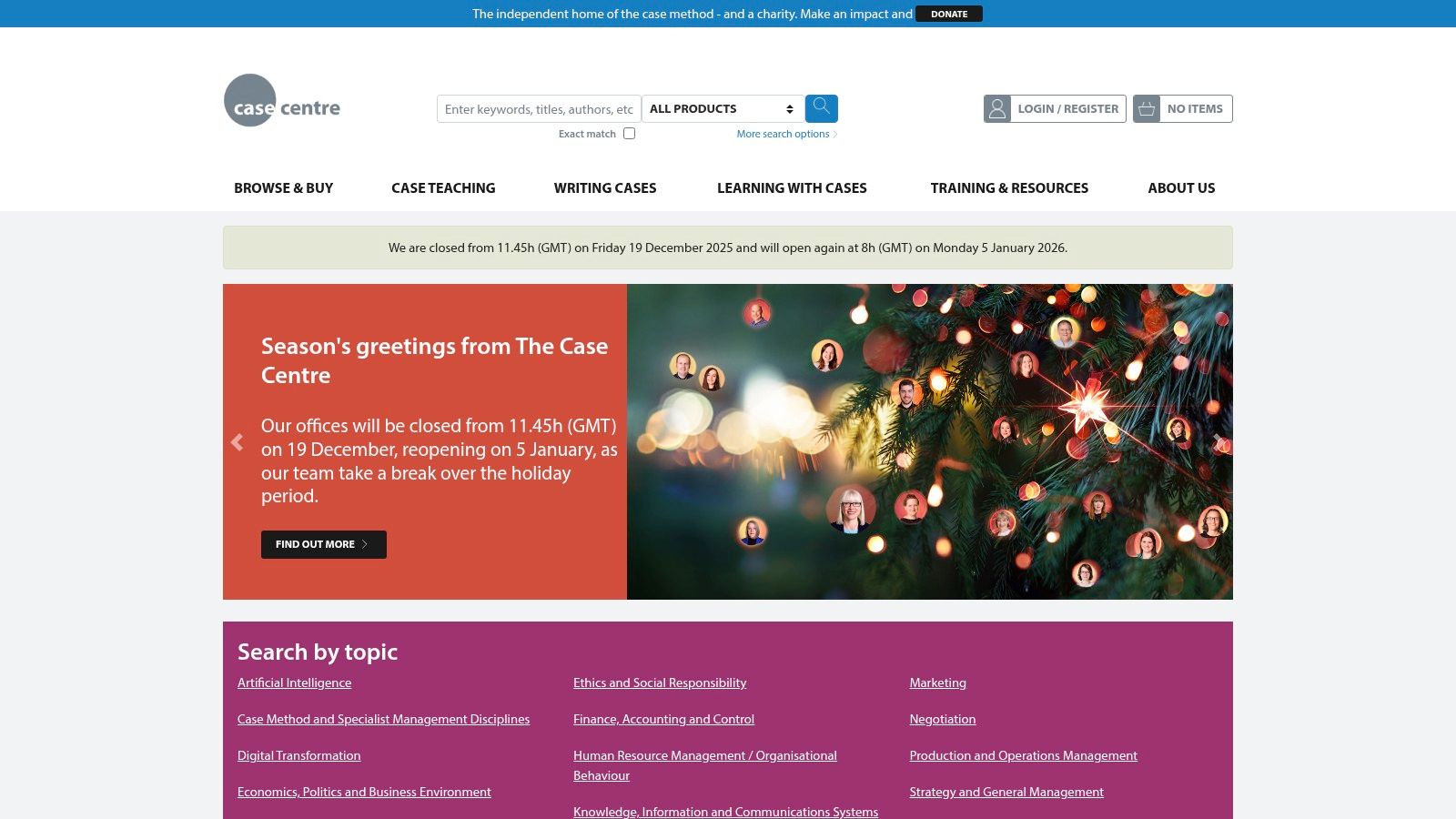
Think of it as the United Nations of business case studies. You can explore how Netflix adapted its model for the Indian market, how a European SaaS company tackled churn, or how Dollar Shave Club’s viral marketing translated into sustainable recurring revenue. This variety gives you a richer, more nuanced understanding of how subscription models perform across different cultures and markets.
Strategic Deep-Dive: Why The Case Centre is a Powerful Resource
The key advantage of The Case Centre is its sheer breadth and accessibility. Instead of being limited to one school's viewpoint, you get access to a melting pot of strategic thought from institutions like INSEAD, London Business School, and Ivey. This diversity is crucial for understanding the universal principles and regional variations of the subscription economy.
Here’s why it’s a vital resource for founders:
- Global Perspectives: Access cases from a wide range of international business schools, providing insights into non-US markets and global expansion strategies.
- One-Stop Search: Its powerful search engine allows you to filter by topic, like "subscription-based model," to quickly find relevant studies from dozens of publishers.
- Transparent Pricing: The platform clearly outlines costs for students, educators, and corporate users, making it easy to budget for your research needs.
Getting the Most Out of The Case Centre
Navigating the site is user-friendly. You can create a free account to browse, preview cases, and purchase individual copies. The platform is particularly useful for building a custom "coursepack" of case studies focused on your specific industry or challenge, whether it's pricing, retention, or customer acquisition.
Key Takeaway: Use the platform to compare and contrast how different companies in the same niche tackled subscription challenges. For example, analyze a case on Spotify alongside one on a smaller, regional streaming service to understand the impact of scale and market dynamics.
While minimum order quantities can apply for classroom settings, individual entrepreneurs can easily purchase single copies for personal study. The prices are competitive, and the ability to access materials from so many esteemed sources in one place makes it an incredibly efficient tool for deep-dive research into subscription business model examples.
- Website: https://www.thecasecentre.org
- Best For: Entrepreneurs and teams looking for a diverse, international collection of case studies on subscription strategies.
- Pricing: Pay-per-item, with clear pricing tiers for academic and corporate use. Previews are often available.
4. Zuora – Subscribed Institute
For entrepreneurs who want to understand the macro trends driving the subscription economy, Zuora’s Subscribed Institute is an essential data hub. As the think tank for Zuora, a leading subscription management platform, the institute provides free, high-level research and data-driven reports that offer a bird's-eye view of how recurring revenue models are performing across different industries.
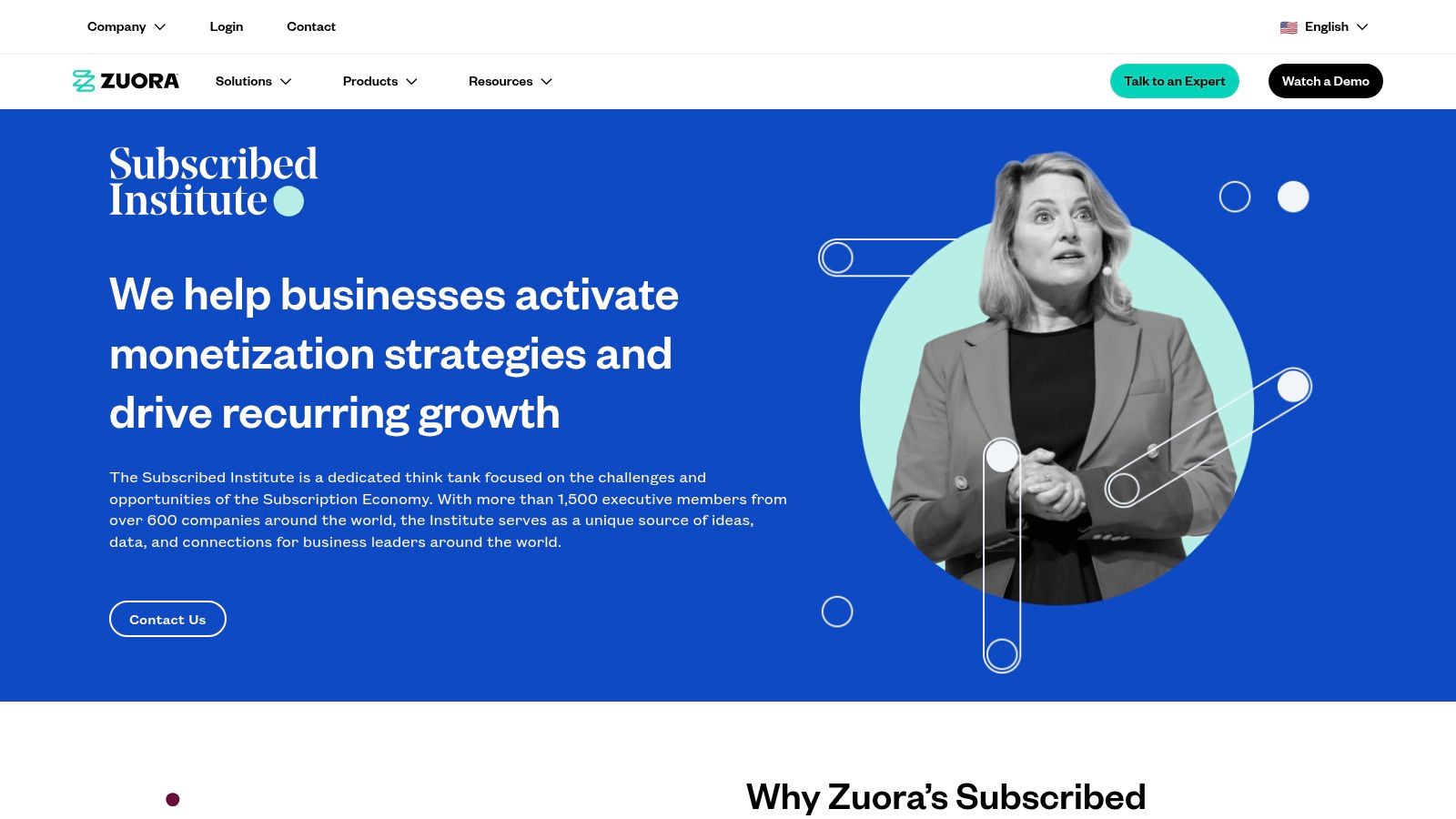
This isn't about individual company case studies; it's about the big picture. The Subscribed Institute analyzes aggregate, anonymized data from hundreds of companies to produce benchmarks and insights. It’s where you go to validate your assumptions with real-world data, understand industry-wide churn rates, and see which sectors are experiencing the fastest growth in the subscription space.
Strategic Deep-Dive: Why the Subscribed Institute is a Key Resource
What sets the Subscribed Institute apart is its quantitative approach. Instead of anecdotes, you get hard data and trend analysis from their flagship report, the Subscription Economy Index (SEI). This report tracks the growth of subscription businesses against traditional product-based companies, giving you powerful data points to use in business plans or investor pitches.
Here’s why it earned its spot on our list:
- Data-Backed Benchmarks: Get access to crucial metrics like industry growth rates, churn averages, and Average Revenue Per User (ARPU) trends.
- Strategic Playbooks: The institute publishes free playbooks on topics like pricing strategies, go-to-market motions, and key subscription metrics.
- Future-Focused Insights: Their research helps you anticipate market shifts and understand the larger economic forces shaping the subscription landscape.
Getting the Most Out of the Subscribed Institute
All resources from the Subscribed Institute are available for free, though you may need to provide an email address to download the reports and playbooks. This makes it an incredibly accessible resource for entrepreneurs at any stage.
Key Takeaway: Download the latest Subscription Economy Index (SEI) report and look for the data specific to your industry (e.g., SaaS, Media, IoT). Use these benchmarks to see how your own business ideas or performance stack up against the market average.
While the insights are powerful, they are often high-level and presented from Zuora's perspective. The goal is to inform your strategy, but you'll need to translate the broad trends into specific, actionable tactics for your own business. It's best used in combination with more granular, company-specific examples.
- Website: https://www.zuora.com/about/subscribed-institute/
- Best For: Founders and strategists looking for data-driven benchmarks and market trends in the subscription economy.
- Pricing: Free (reports and playbooks are available as digital downloads, often requiring email registration).
5. Strategyzer (Examples Library + Books/Courses)
If you need to translate high-level subscription ideas into a practical, visual blueprint, Strategyzer is the go-to platform. It’s famous for popularizing the Business Model Canvas, a tool that helps you map out your entire business on a single page. Their free library is an incredible resource packed with subscription business model examples from global brands.
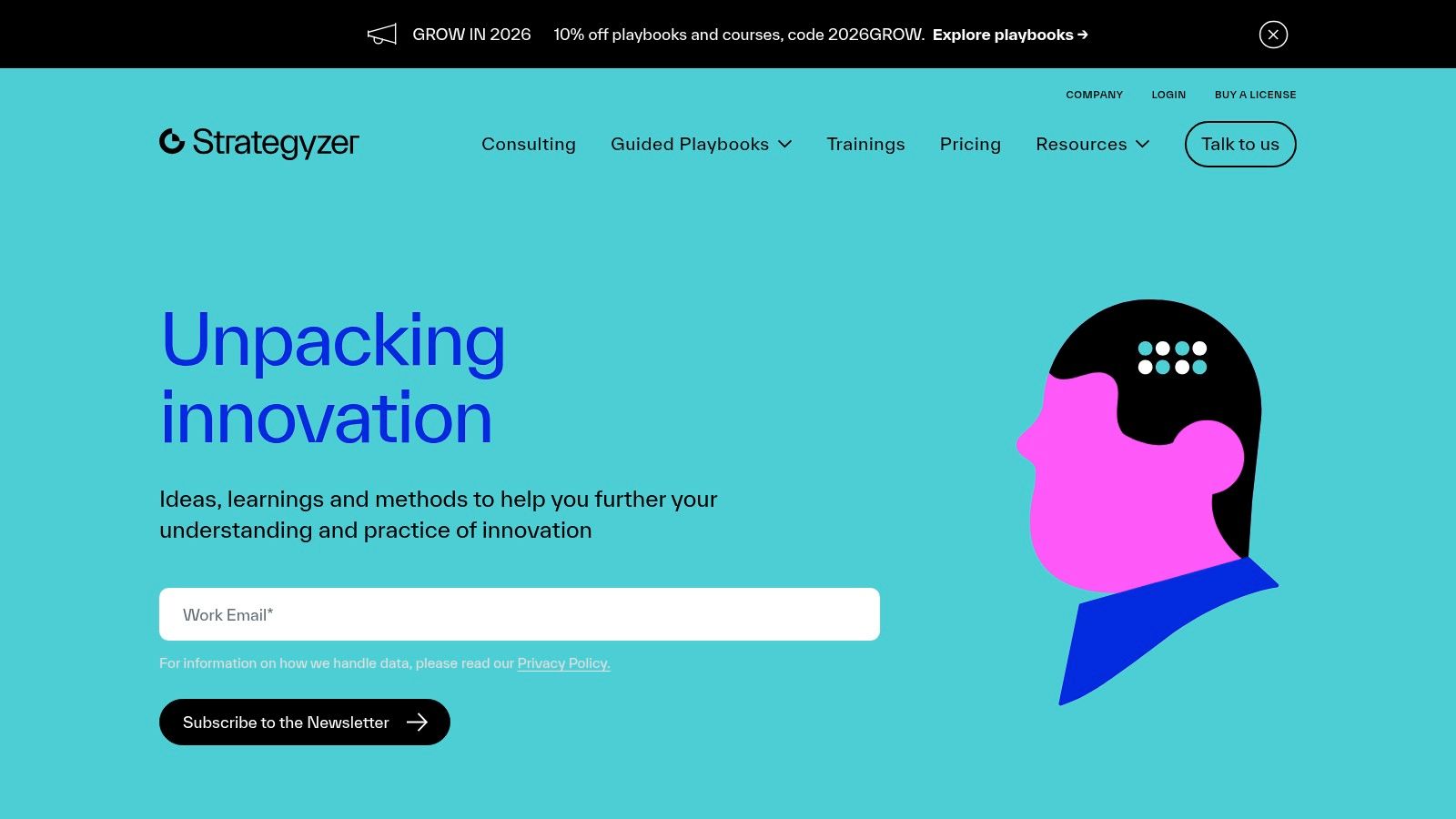
Think of Strategyzer as a bridge between theory and action. It doesn’t just show you that companies like Netflix or Dollar Shave Club are successful; it breaks down how their business models work using visual canvases. This approach makes complex concepts like value propositions, customer segments, and revenue streams incredibly easy to understand and apply to your own venture.
Strategic Deep-Dive: Why Strategyzer is a Must-Use Resource
What sets Strategyzer apart is its practitioner-focused methodology. Instead of just reading a long article, you get a visual, one-page breakdown that clearly shows the mechanics of a subscription model. It forces you to think systematically about how every piece of your business connects, from customer acquisition to your core value delivery.
Here’s why it earned its spot on our list:
- Highly Visual Breakdowns: The Business Model Canvas format makes it easy to see how companies create, deliver, and capture value.
- Actionable Tools: It goes beyond examples by providing the actual canvases and tools (like the Value Proposition Canvas) for you to design and test your own models.
- Focus on Patterns: The library helps you identify recurring patterns in successful subscription businesses that you can adapt for your own strategy.
Getting the Most Out of Strategyzer
The best way to start is by exploring their free library of examples. Pick a company in a niche similar to yours and study its Business Model Canvas. Pay close attention to the connections between their value proposition, customer relationships, and revenue streams.
Key Takeaway: Don't just read the examples. Use a blank Business Model Canvas (available for free on their site) and try to map out your own subscription idea. Compare it side-by-side with successful examples to identify gaps and opportunities in your strategy.
While the core tools and many examples are free, Strategyzer also offers premium online courses and software for teams wanting a more guided experience. The free resources alone, however, provide more than enough value to help you build a solid foundation for your subscription business.
- Website: https://www.strategyzer.com/library
- Best For: Entrepreneurs who want to visually map, design, and stress-test their subscription business model ideas using proven frameworks.
- Pricing: Free access to the examples library and core tools. Paid courses and advanced software are also available.
6. Paddle / ProfitWell (Benchmarks, Metrics, and Content)
If you're building a subscription business, understanding your metrics isn't just important; it's everything. ProfitWell (acquired by Paddle) is an essential tool and resource hub dedicated to helping you master the numbers behind your recurring revenue. It offers free, powerful analytics and backs it up with benchmark-backed content on pricing, retention, and growth levers.
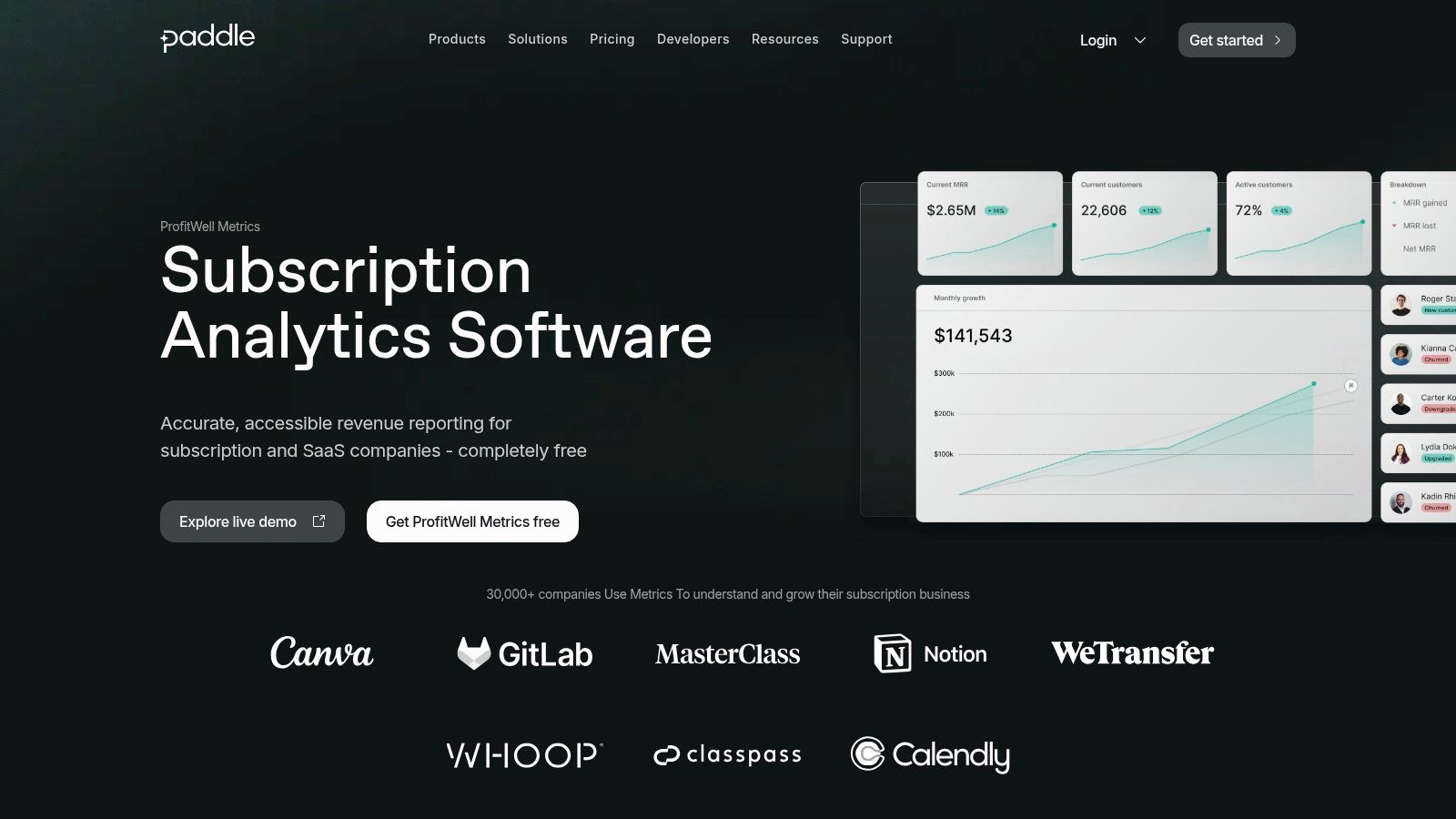
Think of ProfitWell as your command center for subscription health. It pulls data from your payment processor (like Stripe or Paddle) to give you a clear, real-time view of your MRR, churn, lifetime value, and more. It moves beyond just showing your data; it shows you how you stack up against tens of thousands of other subscription companies, providing context that is critical for making smart decisions.
Strategic Deep-Dive: Why ProfitWell is a Must-Use Resource
What sets ProfitWell apart is its combination of a free, powerful product with deeply researched, actionable content. You don’t just get a dashboard; you get a data-driven education on how to improve the numbers you're seeing. It’s one of the most valuable free resources for any entrepreneur exploring subscription business model examples.
Here’s why it earned its spot on our list:
- Free, Best-in-Class Metrics: The platform provides accurate, real-time tracking of essential SaaS and subscription metrics like MRR, churn, LTV, and cohort analysis at no cost.
- Actionable Benchmarking: See how your key metrics compare to similar companies. This helps you identify if your churn is too high or your pricing has room to grow, based on industry-wide data.
- Data-Driven Content: Their blog, reports, and video series (like Pricing Page Teardown) offer tactical advice on pricing strategy, value metrics, and retention, all backed by massive datasets.
Getting the Most Out of ProfitWell
Signing up for ProfitWell Metrics is free and involves connecting your billing system. Once integrated, you'll have access to your core dashboards immediately. The insights you gain are invaluable for diagnosing problems and spotting opportunities for growth.
Key Takeaway: Use the benchmarking feature to set realistic growth targets. If your churn rate is double the industry average for your ARPU, you know exactly where to focus your efforts for the next quarter.
The platform is designed to be a single source of truth for your subscription's financial performance. While the benchmarks provide directional guidance, the real power comes from combining the data in your dashboard with the strategic frameworks shared in their content to optimize your pricing, packaging, and retention funnels.
- Website: https://www.paddle.com/profitwell-metrics
- Best For: SaaS founders and subscription entrepreneurs who need to track metrics and learn data-driven growth strategies.
- Pricing: The core ProfitWell Metrics product is free. Paddle offers other paid products for revenue operations.
7. Amazon (Books on Subscription Models)
Sometimes, the best way to understand the big picture is to step back from individual blog posts and dive into a foundational book. For entrepreneurs wanting to master the theory and practice of recurring revenue, Amazon is the world's biggest library for definitive, example-rich books on subscription business model examples. It's where you'll find essential reads that have shaped the entire industry.
Think of books like Subscribed by Tien Tzuo or The Membership Economy by Robbie Kellman Baxter. These aren't just theoretical guides; they are packed with deep-dive case studies from SaaS, media, and consumer goods. Amazon gives you instant access to these strategic playbooks in whatever format you prefer, be it print, Kindle, or audiobook, making it an indispensable resource for foundational learning.
Strategic Deep-Dive: Why Books are a Foundational Resource
While platforms give you data points, books provide the frameworks to connect them. They compile years of research and consulting experience into a cohesive strategy you can follow. Amazon excels by making this knowledge incredibly accessible, offering a vast catalog complete with reviews, previews, and related recommendations to guide your learning journey.
Here’s why it earned its spot on our list:
- Curated Expertise: Authors like Tzuo and Baxter have spent their careers building and analyzing subscription companies, offering insights you can’t find elsewhere.
- Comprehensive Case Studies: Books often feature detailed analyses of companies like Salesforce, Spotify, and Peloton, explaining the why behind their success.
- Multiple Formats: Absorb the content your way. Listen to an audiobook during your commute, highlight key passages on a Kindle, or keep a physical copy on your desk for reference.
Getting the Most Out of Amazon
The best way to use Amazon for research is to start with a well-known title and then explore the "Customers who bought this item also bought" section. This is a powerful discovery engine for finding niche and new books on subscription strategy.
Key Takeaway: Use the "Look Inside" feature to preview a book's table of contents and introduction. This helps you quickly assess if the case studies and frameworks are relevant to your specific business goals before you commit to buying.
Pricing and availability can fluctuate, so add promising titles to your wishlist to monitor price drops. With Prime delivery, you can have a physical book in your hands in a day or two, and digital versions are available instantly. While some books may be older, their core principles on value, retention, and community are timeless.
- Website: https://www.amazon.com
- Best For: Entrepreneurs looking for foundational, expert-led books and comprehensive case studies on subscription strategy.
- Pricing: Varies by book and format (print, Kindle, audiobook). Prices for popular business books typically range from $15 to $30.
7-Source Comparison: Subscription Model Resources
| Resource / Platform | Implementation Complexity 🔄 | Resource Requirements ⚡ | Expected Outcomes 📊 | Ideal Use Cases 💡 | Key Advantages ⭐ |
|---|---|---|---|---|---|
| Remotepreneur | Low — browseable case hub; membership optional 🔄 | Low–Med — time to research; paid membership for extras ⚡ | Actionable, case-driven paths and execution tools; fast idea validation 📊 | Early founders researching remote business models, side‑hustle to scale | Filterable real-world revenue breakdowns; practical tools & community ⭐ |
| Harvard Business Publishing Education (HBPE) | Medium — purchase & integrate cases into curriculum 🔄 | Med–High — per‑case costs; educator accounts for instructors ⚡ | Authoritative, classroom-ready cases with teaching notes 📊⭐ | University courses, executive education, formal teaching assignments 💡 | Gold‑standard cases; clear academic licensing and instructor resources ⭐ |
| The Case Centre | Medium — search, preview, assemble coursepacks 🔄 | Medium — per‑copy pricing, possible minimum orders ⚡ | Broad international case selection and licensing options 📊 | Instructors or trainers needing diverse, global case examples 💡 | Large, multi‑publisher catalog with transparent pricing ⭐ |
| Zuora – Subscribed Institute | Low–Med — download/read reports; some analysis required 🔄 | Low (reports) — may need tooling/consulting to act on insights ⚡ | Data‑driven benchmarks, subscription metrics and frameworks 📊 | Strategy teams, revenue ops, benchmarking subscription performance 💡 | Dataset-backed research and recurring‑revenue benchmarks ⭐ |
| Strategyzer (Library + Courses) | Low–Med — consume visuals; paid tools/courses optional 🔄 | Low–Med — free examples; paid tools for deeper work ⚡ | Visual model breakdowns and design frameworks for testing models 📊 | Practitioners designing business models, workshops and prototyping 💡 | Highly visual frameworks (Business Model Canvas) and pattern libraries ⭐ |
| Paddle / ProfitWell | Medium — integrate billing & use dashboards 🔄 | Low–Med — free analytics tier; integration effort for full value ⚡ | Operational metrics, cohort analysis and pricing/retention guidance 📊⭐ | Early‑to‑growth subscription companies optimizing pricing & retention 💡 | Free analytics + benchmarked recommendations tied to pricing actions ⭐ |
| Amazon (Books on Subscription Models) | Low — purchase and read; no setup 🔄 | Low — cost of books; time to read ⚡ | Deep narrative case studies and foundational frameworks; long‑form learning 📊 | Self‑study, foundational reading for founders and managers 💡 | Vast selection, multiple formats, reviews/previews for selection ⭐ |
From Inspiration to Action: Building Your Subscription Empire
We've journeyed through a powerful collection of resources and subscription business model examples, moving from the strategic insights of the Subscribed Institute to the practical benchmarks from ProfitWell. The landscape is rich with opportunity, but the single most important lesson is this: success isn't found in a template, but in adaptation.
The common thread weaving through every successful model, from Strategyzer's visual canvases to Amazon's vast library of case studies, is an unwavering focus on delivering continuous, evolving value. A subscription isn't just a transaction; it's a relationship. Your ability to nurture that relationship determines your long-term viability.
Your Roadmap to Recurring Revenue
As we've seen, the path to a thriving subscription business is paved with strategic decisions, not just a great idea. The examples highlighted in this article underscore several core principles that you must internalize before you write a single line of code or design your first landing page.
Here are the key takeaways to guide your next steps:
- Value is Your North Star: Your subscription must solve an ongoing problem or fulfill a recurring desire. As seen with HBPE and The Case Centre, the value is in the constant access to fresh, relevant educational materials that help professionals excel. Define what ongoing value you will provide.
- Pricing is a Science: Don't just pick a number. Use resources like Paddle/ProfitWell to understand industry benchmarks and customer willingness to pay. Your pricing tiers should directly reflect the value delivered, guiding customers on a clear upgrade path.
- Retention is the Real Growth Engine: Acquiring a new customer is expensive. Keeping one is profitable. The most successful subscription businesses are obsessed with reducing churn by constantly engaging their community, improving their product, and listening to feedback.
- The Right Tools Amplify Your Efforts: Whether it's a payment processor like Paddle or a strategic tool like Strategyzer, technology is your operational backbone. The goal isn't to have the most tools, but the right tools that automate, simplify, and provide data for better decision-making.
Choosing Your Tech Stack and Taking Action
Getting started can feel overwhelming, but you can break it down into manageable steps. Your immediate goal is to move from analysis to action. Start by asking yourself a few critical questions to guide your tool selection and implementation.
1. What is my core business model?
* For Content & Community: Look at platforms that specialize in memberships and content gating.
* For SaaS: Your focus will be on billing systems that handle complex pricing, trials, and dunning.
* For E-commerce Boxes: You'll need a platform with strong inventory and logistics management.
2. What is my budget and technical skill level?
* If you're non-technical and on a tight budget, all-in-one platforms can be a great starting point.
* If you have development resources, a more flexible, API-first tool might be a better long-term choice.
3. What metrics will I track?
* Ensure your chosen tools provide a clear dashboard for critical subscription metrics like Monthly Recurring Revenue (MRR), Churn Rate, and Customer Lifetime Value (LTV). What gets measured gets managed.
By answering these questions, you can cut through the noise and select a foundational toolset that supports your specific vision. From there, it's about launching a minimum viable product (MVP), gathering feedback, and iterating. This journey is a marathon, not a sprint, and these subscription business model examples are your map and compass. Use them to navigate the path, avoid common pitfalls, and build something that lasts.
Ready to see how real-world remote entrepreneurs have applied these principles to build their own subscription empires? Remotepreneur offers deep-dive playbooks and case studies that break down the exact strategies, tools, and tactics used to build profitable, location-independent businesses. Explore our resources to turn your subscription idea into a reality at Remotepreneur.
