
When you're starting a freelance business, everything really boils down to four key areas. You need to nail down a profitable niche, build a brand and portfolio that turns heads, get your legal and financial house in order, and create a client-finding system you can count on. Get these right, and you’re well on your way to building a business you can run from anywhere.
Finding Your Profitable Freelance Niche
Let's be real: choosing your niche is the single most important decision you'll make. It’s the bedrock for your brand, your pricing, and how you find clients. Without a clear focus, you'll end up being a jack-of-all-trades, constantly fighting for low-paying gigs and competing on price alone.
So many new freelancers fall into the trap of casting a wide net. They say things like, "I'm a writer," or "I'm a developer." And while that’s true, it’s far too vague to attract the clients you really want. Specificity is what signals expertise, and expertise is what gets you paid well.
Think about it. If a pipe bursts in your kitchen, are you calling a general handyman or a plumber? You’re calling the plumber. Why? Because you trust their specialized skills to solve your very specific—and very urgent—problem. Your freelance business is no different. Clients with expensive problems don't look for generalists; they seek out specialists.
Moving From Broad Skills to a Specific Niche
The trick is to connect what you do with who you do it for and the problem you solve. You stop selling a generic skill and start offering a targeted solution.
For instance, a generalist "writer" transforms into a specialist when they frame their services like this:
- A B2B SaaS content writer who helps tech companies get more demo sign-ups with SEO-focused blog posts.
- A health and wellness copywriter who crafts email campaigns for direct-to-consumer supplement brands.
Same goes for a developer. Instead of just "building websites," they become:
- A Shopify Plus expert who handles custom app integrations for growing ecommerce stores.
- A Webflow developer for VC-backed startups needing slick, high-performance marketing sites.
See the difference? This kind of focus makes your marketing a million times easier. You know exactly who to talk to, what to say on your website, and which portfolio pieces will actually land you the job.
My two cents: A niche isn't about closing doors. It's about focusing your energy where you can deliver the most value. When you do that, you can charge a premium. Specialists get hired to solve problems; generalists get hired to check off tasks.
The infographic below breaks down a simple, three-step approach to finding and packaging your unique freelance service.
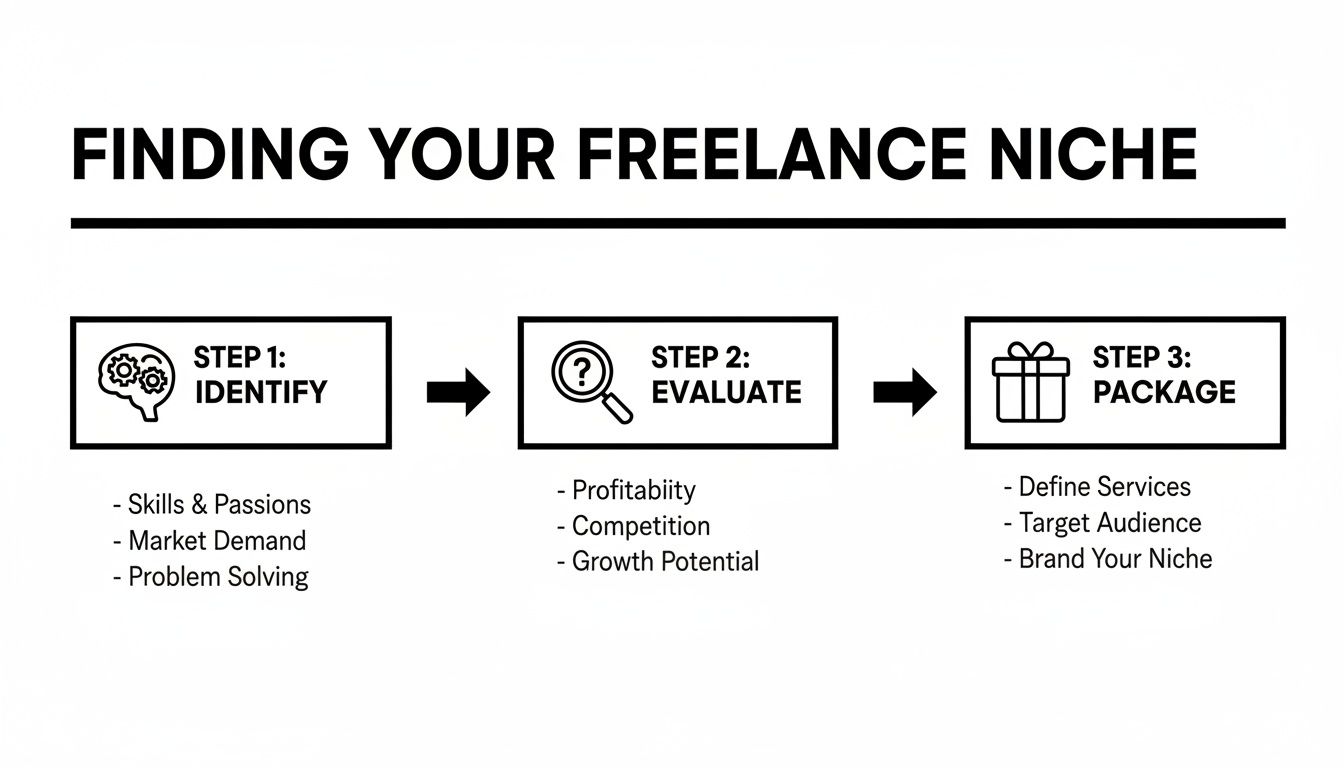
This framework helps you move from just having a skill to offering a marketable service that people will actually pay for.
How to Identify and Validate Your Niche
Finding your sweet spot is part self-discovery, part market research. First, look inward. Jot down your skills, your professional background, and even your hobbies. What industries do you get? What topics could you talk about all day? What kinds of problems do you genuinely enjoy untangling?
Once you have a few ideas, it's time to see if they have legs. You're looking for signs of a healthy market:
- Are companies already paying for this? Poke around on LinkedIn, niche job boards, and freelance sites. If you see active listings for your potential niche, that's a great sign.
- Is there a real "pain point"? The most profitable niches solve expensive problems. Does your service help businesses make more money, save time, or lower their risk?
- Can you picture your ideal client? You should be able to describe the exact person or company that needs you most. If you can't, your niche might be too broad.
Don't forget, the freelance economy is massive. There are 1.57 billion freelancers worldwide out of a total global workforce of 3.38 billion. That's a staggering 46.6% of all workers. The market is definitely there; your job is just to find your perfect corner of it. If you're curious, you can learn more about the growth of the global freelancing market.
Building Your Brand and a Client-Winning Portfolio

Alright, you’ve picked your niche. Now comes the fun part: crafting a brand that makes your ideal clients sit up and pay attention, and building a portfolio that proves you’re the real deal.
Think of your brand as your professional handshake—it’s the promise you make to your clients. Your portfolio is the follow-through, the undeniable proof that you can deliver on that promise.
So many new freelancers get hung up here, thinking they need a slick logo and a custom-coded website right out of the gate. You don't. What you really need is a crystal-clear message that shows your value.
At its core, a strong brand immediately answers three questions for a potential client:
- What exactly do you do?
- Who do you do it for?
- What results can I expect if I hire you?
Getting this right is your biggest marketing advantage. It’s what separates the forgettable generalists from the in-demand specialists who charge premium rates.
Crafting Your Core Brand Message
Let's start simple: your business name. You can absolutely just use your own name, like "Jane Smith Consulting." This is perfect for building a personal brand where you are the product. Alternatively, you could go for something more descriptive that screams your niche, like "SaaS Content Pro."
Next up is your one-sentence pitch. This is your secret weapon for your LinkedIn bio, email signature, and any networking event. It’s a short, powerful statement that does the selling for you.
Here's a dead-simple formula to get you started: I help [Ideal Client] achieve [Desired Outcome] by providing [Your Service].
Let’s see it in action:
- A graphic designer could say, “I help early-stage startups build brand credibility with professional pitch decks and marketing collateral.”
- A virtual assistant might say, “I help busy online coaches get their time back by managing their scheduling, email, and social media.”
That one sentence instantly qualifies leads and positions you as a problem-solver, not just another person with a skill.
Your brand isn’t about flashy design; it’s about clarity and consistency. When a client understands exactly how you can help them, you’ve already won half the battle.
This kind of sharp positioning is more critical than ever. The demand for freelancers is skyrocketing—a recent study found that 48% of CEOs are planning to hire more freelance talent. On top of that, online gig postings shot up by about 41% between 2016 and 2023. The opportunities are out there for freelancers who know how to stand out. You can dig into more of the corporate demand for freelancers to see the trend for yourself.
Building a Portfolio When You Have No Clients
"But how do I build a portfolio if I haven't had any clients?" I hear this all the time. It's the classic chicken-or-the-egg problem, but trust me, it's easier to solve than you think. You don't need paid work to create pieces that will wow potential clients.
The goal is to show, not just tell. Here are three of my go-to strategies for building a killer portfolio from scratch.
1. Create "Spec" (Speculative) Projects
A spec project is something you create on your own, either for a made-up client or for a real brand you'd love to work with. Pick a company in your niche and produce the exact type of work you want to get paid for.
- For a Copywriter: Write a new landing page or a three-part email sequence for a SaaS company you admire.
- For a Web Developer: Mock up and build a new homepage concept for a local business with a horribly outdated website.
- For a Social Media Manager: Create a one-month content calendar, complete with sample posts, for a popular e-commerce brand.
2. Repackage Your 9-to-5 Experience
Don't discount your day job—it's a goldmine of portfolio material. You just need to shift your mindset and frame your past work as if you were a business owner.
Instead of a boring list of job duties, present specific projects you worked on and the results they got. Managed the company blog? Showcase the top-performing articles. Designed an internal sales presentation? That’s now a case study on effective visual communication.
3. Do One Strategic Pro Bono Project
Working for free gets a bad rap, but it can be a brilliant move if you're strategic about it. Find one local nonprofit or a small business you genuinely believe in. Offer to do a single, well-defined project for them in exchange for two things: a glowing testimonial and the right to feature the work in your portfolio. This nets you a real-world project and valuable social proof.
Nailing Your Numbers: Pricing and Money Management
Figuring out what to charge is probably the most nerve-wracking part of going freelance. It’s a classic Catch-22. Go too high, and you worry about scaring people off. Go too low, and you’re booking a one-way ticket to burnout city.
The secret? Stop guessing and start calculating. Your rate isn't just some number you pull out of thin air; it's the financial engine of your entire business. It has to cover your software, your salary, your taxes, and still leave a little extra. Getting this right from day one is what separates a stressful side-hustle from a sustainable, profitable career.
Choosing Your Freelance Pricing Model
Before you can even think about a number, you have to decide how you're going to charge. The structure you choose can totally change your day-to-day workflow and how much you can actually earn.
Here’s a look at the three most common pricing models and a little guidance on which might be the best fit for you right now.
| Pricing Model | Best For | Pros | Cons |
|---|---|---|---|
| Hourly Rate | Beginners or projects with a fuzzy scope where requirements might change. | Simple to understand and guarantees you're paid for all your time, including extra meetings or revisions. | Can penalize you for being efficient. Clients may micromanage your hours. |
| Project-Based Rate | Clearly defined projects with specific deliverables, like a logo design or a 5-page website. | You’re rewarded for working faster, and the client knows the total cost upfront. | Scope creep is a major risk if the project isn't well-defined. You can lose money if you underestimate the time needed. |
| Retainer Agreement | Ongoing, recurring work for established clients, like social media management or monthly SEO. | Creates stable, predictable income—the holy grail for freelancers! Fosters long-term client relationships. | Can be harder to land without first proving your value. Requires consistent delivery of results each month. |
Deciding on a model isn't a life-long commitment. You can and should adapt your pricing strategy as you gain experience and as your client relationships evolve.
A lot of seasoned freelancers play the long game. They'll start a new client with a fixed project fee to build trust and show what they can do, then smoothly transition them to a monthly retainer once they're hooked.
How to Calculate a Rate That Actually Works
Alright, let's ditch the anxiety and do some simple math. A profitable rate isn't based on what you feel you're worth; it's based on what you need to earn. We'll start by figuring out your bare-minimum survival number and then build a healthy profit margin on top of that.
The easiest way to get a realistic hourly rate is to work backward from your dream salary.
Your Target Annual Income
First, what do you actually want to make in a year? Be ambitious but realistic. Let’s use $70,000 as our goal.
Add Your Business Expenses
Next, tack on all your business costs. Think software subscriptions, marketing, maybe a coworking space. Let's estimate $5,000 a year. That brings our new total to $75,000.
Don’t Forget Uncle Sam (Taxes)
As a freelancer, you're responsible for your own taxes. A good rule of thumb is to set aside 30% of your total revenue. So, $75,000 x 0.30 = $22,500. Now your total revenue goal is $97,500. This is the number you actually need to bring in.
Figure Out Your Billable Hours
Here's a dose of reality: you won't be billing clients 40 hours a week, 52 weeks a year. You have to spend time on marketing, answering emails, and, you know, taking a vacation. A more realistic number is 25 billable hours per week for 48 weeks of the year. That gives you 1,200 billable hours annually.
Do the Final Math
Now, just divide your total revenue goal by your billable hours:
$97,500 / 1,200 hours = $81.25 per hour
This $81.25/hour is your north star. It’s the baseline you can use to build quotes. If a project looks like it will take you 20 hours, you can confidently quote $1,625 ($81.25 x 20) and know you're covering all your bases.
Keeping Your Business Finances in Order
Once the money starts rolling in, you need a dead-simple system to manage it. So many new freelancers trip up here, and it creates massive headaches later on.
Open a Separate Business Bank Account
Seriously, do this yesterday. It’s a non-negotiable. Mixing your personal and business spending is a surefire way to make accounting a nightmare. A dedicated business checking account keeps everything clean and makes tracking your income and expenses a breeze.
Track Every Penny
Get yourself some simple accounting software like FreshBooks or Wave, or even just a well-organized spreadsheet. Log every single dollar that comes in and goes out. This isn't just for taxes; it shows you if you're actually profitable.
Become a Religious Tax Saver
The tax man will come for his share, and you don't want to be caught off guard. Make it a habit: every single time a client pays you, immediately transfer 25-30% of that payment into a separate savings account. Label it "TAXES" and don't touch it. This one discipline will save you a world of pain.
How to Find and Win Your First Clients

You’ve nailed down your niche, built a portfolio that shines, and figured out your pricing. This is where the rubber meets the road—landing that first paying client. Honestly, a freelance business is just a well-organized hobby until someone pays you. This is the moment your hard work turns into a real, thriving business.
The great news? You don't need a huge marketing budget or a massive social media following to get going. What you absolutely do need is a solid, repeatable strategy for getting in front of the right people and showing them you're the answer to their prayers.
Let’s get one thing straight, though: sitting back and waiting for clients to stumble upon your website is a recipe for a painfully slow start. In the beginning, you have to be the engine. You have to be proactive. That means putting yourself out there, starting conversations, and building a system that keeps new opportunities flowing in.
Using Freelance Marketplaces the Smart Way
Freelance marketplaces like Upwork, Fiverr, or Toptal can feel like a race to the bottom on price. But approached correctly, they can be absolute goldmines, especially when you're starting out. The trick is to use them strategically, not as a source of cheap, one-off gigs.
Your mission is to stand out from the crowd by zeroing in on high-quality job posts that are a perfect match for your niche. Stop applying to every generic "writer needed" post. Instead, hunt for the clients who are describing a very specific problem you know exactly how to solve. This is where all that niche-defining work you did pays off, big time.
When you craft your proposal, make it all about them. A truly winning proposal does three things exceptionally well:
- It proves you actually read the job post. Reference specific details or ask intelligent questions about their project to show you’re not just copy-pasting a template.
- It diagnoses their problem and hints at the cure. Briefly touch on why they’re facing this issue and how your specific skills are the remedy.
- It offers clear proof. Link directly to the most relevant piece in your portfolio that screams, "I've solved this exact problem before!"
Expert Tip: Think of your Upwork or Fiverr profile as a sales page, not a resume. Your headline should be your powerful one-sentence pitch. Fill out the rest with client-focused language that screams results, not just a list of skills.
The Power of Warm Outreach and Your Existing Network
Your first client is very often hiding in plain sight. Before you even think about sending a single cold email, tap into the network you’ve already built. We're talking about former colleagues, old bosses, friends, even family.
This isn't about awkwardly begging for work. Not at all. Think of it as an "information tour." You're just reaching out with a simple, no-pressure message.
Here’s a template you can adapt:
"Hey [Name], hope you’re doing well! I’ve just launched my own freelance business helping [Ideal Client] with [Your Service]. Since you’re so well-connected in the [Industry] world, I was wondering if you know anyone who might be struggling with [Client Pain Point]? Any introductions would be a massive help!"
This simple shift turns your contacts into a referral network. Don't underestimate this. Client referrals are the top way freelancers find work—a whopping 66% of freelancers point to them as a primary source of new leads. You can dig into more stats on how freelancers find work to see just how powerful this is.
Mastering the Art of the Cold Email
Once you've worked through your warm network, it's time to embrace cold outreach. A well-crafted cold email can work wonders, but a lazy one gets deleted in under three seconds. The difference almost always comes down to one thing: personalization.
Your job is to find a genuine, specific reason to be in their inbox. Scour their LinkedIn profile, company blog, or recent press releases for a hook.
- Did their company just land a new round of funding? Congrats! Mention how your services can help them manage that growth.
- Did you spot a glaring SEO mistake or a broken link on their website? Point it out (gently!) and offer a quick fix.
- Did their founder post something on LinkedIn you genuinely found insightful? Reference it in your opening line.
This isn't about flattery; it's about proving you've done your homework. Keep your email short, focused on one clear call-to-action (like a "brief 15-minute chat"), and always, always make it about the value you can provide to them.
From Proposal to Paid Project
So, you got a positive response. Nice! The final leg of the race is usually a discovery call followed by a formal proposal. On this call, your primary job is to listen. Shut up and listen. Understand their goals, their deepest frustrations, and what a "win" looks like in their eyes.
After the call, follow up with a simple, clean, one-page proposal that recaps the conversation and lays out your recommended solution.
Make sure your proposal includes these four key pieces:
- The Problem: State their challenge back to them, using their own words.
- The Solution: Detail your game plan and the specific deliverables.
- The Investment: Clearly state your project fee. No fuzzy math.
- The Next Steps: Tell them exactly what to do to start (e.g., "To get the ball rolling, just reply 'approved' to this email…").
Winning that first client is a massive milestone. It's the moment of validation. By combining the broad reach of marketplaces, the trust of your personal network, and the directness of smart outreach, you'll build a powerful, repeatable engine to grow your freelance business from day one.
Delivering Great Work and Actually Scaling Your Business
Okay, so you’ve landed a client. Pop the champagne! But don't get too comfortable, because this is where the real work begins. The difference between a freelance career that fizzles out and one that thrives isn't just about finding clients—it's about keeping them.
Happy clients are the secret sauce. They're the ones who leave you glowing testimonials, send a steady stream of referrals your way, and eventually sign those dreamy retainer contracts that create predictable income.
The trick is to stop thinking project-to-project and start acting like a true business owner. This means building simple, repeatable systems that ensure you knock it out of the park every single time. It's about making the entire client journey—from "yes" to "here's the final invoice"—so smooth and professional that they can't imagine working with anyone else.
Crafting an Unforgettable Client Experience
Let’s be honest: your process is your product. A well-oiled workflow doesn't just make your life easier; it screams professionalism. It tells your client you’ve done this before and you know exactly what you’re doing, building the trust you need for a lasting partnership.
It all starts with a rock-solid onboarding process. The moment that proposal is signed, don't just dive headfirst into the work. Kick things off with a structured welcome that gets you all the info you need while making them feel completely confident in their decision to hire you.
A great onboarding flow usually includes:
- A Welcome Packet: A simple, clean PDF that lays out the ground rules—your communication hours, how you prefer to chat, and a quick look at the project timeline and key milestones.
- An Intake Form: This is your secret weapon against endless email chains. Build a form that asks every single question you need answered to do your job well.
- A Kickoff Call: Keep it short and sweet. A 30-minute call is perfect for aligning on goals, confirming you have everything, and just putting a voice (and maybe a face) to the name.
Starting this way nips scope creep in the bud and gets everyone on the same page from day one. It's the first real step you take from being just another freelancer to becoming a valued partner.
Your client experience is the most powerful, yet most underrated, marketing tool you have. It's what turns a one-off gig into a multi-year retainer and generates word-of-mouth referrals that blow any cold email out of the water.
Moving From Freelancer to Business Owner with Systems and Tools
As you start to juggle a few clients at once, your brain stops being a reliable hard drive for deadlines and details. You need some simple tools to keep all the plates spinning. Don't go overboard with complex, expensive software—a couple of smart choices are all you need.
Start with a basic project management system. Something like Trello or Asana is perfect. Just create a simple board for each client with columns like "To Do," "In Progress," and "Done." This gives you a bird's-eye view of everything on your plate.
Communication is the other piece of the puzzle. You need a system for it. A simple habit like sending a Friday recap email—outlining what you got done this week and what's next—can do wonders. It keeps the client in the loop, calms their nerves, and quietly reminds them of the value you're delivering.
Smart Ways to Scale for Long-Term Growth
Once your delivery process is humming along nicely, it's time to think bigger. Scaling isn't about cramming more hours into your day. It’s about making more money from the hours you already work.
When and How to Raise Your Rates
Are you booked solid for the next couple of months? Turning away projects? That’s your sign. It's time for a rate increase.
A painless way to do this is to raise your rates by 10-20% with every new client you bring on. This way, you’re gradually leveling up your income without any awkward conversations.
For your existing clients, give them a generous heads-up. Let them know your rates are going up in two or three months, but because you love working with them, you want to give them the chance to lock in their current rate for another six or twelve months on a new contract. It's a win-win.
Pitching Retainer Agreements
Retainers are the holy grail of freelancing. They turn unpredictable project fees into stable, recurring revenue. It’s an absolute game-changer.
The perfect time to pitch a retainer is right after you’ve successfully wrapped up a one-off project. Ride that wave of success and propose an ongoing partnership. Don't just talk about tasks; frame it around their big-picture goals and show them how your continued help will get them there.
Outsourcing and Building a Small Team
Sooner or later, you'll hit a wall. You just can't take on more work without your sanity or the quality of your work taking a nosedive. This is the moment you graduate from freelancer to business owner.
Start small by delegating the tasks that eat up your time but don't require your unique genius.
- Admin Stuff: A virtual assistant (VA) can be a lifesaver for handling your calendar, invoicing, and filtering your inbox.
- Complementary Skills: Are you a writer? Partner with a graphic designer. A web developer? Team up with a copywriter.
Bringing in help frees you up to focus on the high-value work: client strategy, business development, and landing those bigger, more profitable projects. This is how you build a business that truly works for you.
Got Questions? I’ve Got Answers.
When you're first dipping your toes into the freelance world, it feels like a million questions pop up at once. Don't worry, that's totally normal. Let's walk through some of the big ones that trip up almost every new freelancer.
One of the first things people ask is, "Do I need a business license right now?" Honestly, for most solo freelancers in the U.S., you can start as a sole proprietorship. This just means you're doing business as yourself, under your own name, with no special paperwork required to get going. It's the simplest way to start.
Then there's the contract question. Is it overkill for a small, quick project? Absolutely not. Think of a contract as a simple friendship bracelet for your business relationship—it keeps everyone on the same page. It doesn't have to be a 20-page legal document; a clear, one-page agreement outlining the scope, payment terms, and deadline can save you from massive headaches later. A resounding yes, always use one.
Let's Talk Taxes and Insurance
Okay, let's tackle the scary stuff: taxes. They feel way more intimidating than they actually are. The trick is to be prepared from day one. As a freelancer, you're the one responsible for handling your income taxes, so you need a system.
Here's my non-negotiable rule: every single time a client payment hits your account, immediately move 25-30% of it into a separate savings account. Just for taxes. Don't touch it. This simple habit will save you from a world of panic when tax season hits.
And what about insurance? It’s not always required, but having liability insurance is a smart safety net. If you're a consultant, designer, or in any field where a mistake could cost your client money, it’s a must-have. It protects you from the what-ifs.
The single biggest mistake I see new freelancers make is waiting for the "perfect" moment to launch. Your business is a living thing; it will grow and change. The most important thing you can do is just start, learn as you go, and fine-tune your process along the way.
So, how many clients should you juggle? There's no magic number here. When you're just getting your feet wet and learning how to start a freelance business, I've found that focusing on 1-3 clients at a time is the sweet spot. It lets you deliver amazing work without burning out.
