
Marketing a service isn't like selling a product you can hold in your hand. You're not just selling a deliverable; you're selling trust, expertise, and the promise of a future result. Whether you're a freelancer fighting for your first client, an agency owner ready to scale, or a coach building a dedicated community, the path to sustainable growth can feel frustratingly unclear.
Traditional marketing advice often misses the mark. It offers generic tips that simply don't account for the unique, relationship-driven nature of a service business. You need more than just platitudes; you need a playbook filled with actionable marketing strategies for service businesses that actually work.
This guide is that playbook.
We’re diving deep into 10 proven strategies tailored specifically for service providers like you. Each one is a complete mini-roadmap, detailing not just what to do, but why it works, how to implement it step-by-step, and what to expect in terms of cost and time. You’ll find real examples and learn which metrics matter most, helping you prioritize your efforts whether you're just starting out or preparing for your next big growth phase.
Forget vague theories. From establishing unshakeable authority with content marketing to engineering referral programs that bring ideal clients directly to your inbox, this comprehensive guide is your blueprint for predictable client acquisition and building a thriving service business. Let’s get started.
1. Build Authority with Content Marketing & Thought Leadership
Unlike selling a physical product, service businesses sell expertise, trust, and a promised outcome. Content marketing is how you make that intangible value tangible. It’s about creating and sharing valuable, free content to attract, engage, and convert your target audience into clients, proving your expertise before they ever spend a dime.
This isn’t about just blogging; it’s about establishing yourself as a leading authority in your niche. By consistently sharing your unique insights, methodologies, and client successes, you build a powerful moat around your business that competitors can't easily replicate. This is a foundational element in many effective marketing strategies for service businesses.
Why It Works for Service Businesses
When clients hire a service provider, they are buying confidence. They need to believe you can solve their problem. Thought leadership content provides the proof. It showcases your deep understanding of their challenges and demonstrates your ability to deliver results, effectively de-risking the purchase decision for them.
How to Implement This Strategy
- Identify Your "Spike": What’s your unique point of view? Don’t just repeat what everyone else says. Maybe you have a contrarian take on a common industry practice or a proprietary framework for achieving results. This is your content's "hook."
- Choose Your "Pillar" Format: Focus on one primary content type to master first. This could be in-depth blog posts, a YouTube channel with video tutorials, or detailed case studies that break down your process.
- Create "Proof-Based" Content: Shift from generic advice to content that proves your value. Share client success stories (with permission!), transparently break down your process for a specific task, or create a step-by-step guide that showcases your exact methodology.
Key Insight: The goal isn’t just to educate, but to demonstrate. Show, don’t just tell. A detailed case study showing a 150% ROI for a client is infinitely more powerful than a blog post titled "5 Ways to Increase ROI."
Micro Case Study: Ahrefs
While Ahrefs sells a SaaS product, their marketing playbook is a masterclass for service businesses. They invest heavily in creating highly detailed, data-driven blog posts and YouTube tutorials that teach advanced SEO and marketing concepts. They give away immense value for free, which in turn builds immense trust and establishes them as the go-to authority in the SEO space. As a result, when people need an SEO tool, Ahrefs is top-of-mind.
- Business Stage: Ideal for all stages, but crucial for Early-Stage businesses to build initial credibility.
- Cost & Time: Low financial cost if you create it yourself, but high time investment. Expect 4-10 hours per high-quality content piece.
- Key Metrics: Organic traffic, keyword rankings, lead magnet downloads, and consultation requests attributed to content.
2. Community Building & Network Effects
Service businesses thrive on relationships and trust, and a community is where those elements are forged at scale. This strategy is about creating a dedicated space-like a Slack group, forum, or membership platform-where your ideal clients and peers can connect, share experiences, and support each other. It transforms your marketing from a one-to-many broadcast into a many-to-many conversation.
As more members join and contribute, the value of the community grows for everyone, creating powerful network effects. This ecosystem becomes a self-sustaining source of referrals, testimonials, and deep client insights, making it a potent marketing strategy for service businesses that prioritize long-term relationships over short-term transactions.

Why It Works for Service Businesses
Clients often hire service providers to navigate complex challenges, and they crave connection with others on a similar journey. A community provides that peer support and a direct line to your expertise, fostering immense loyalty. It positions you not just as a service provider, but as a central figure in their professional world, making your services the natural choice when a need arises.
How to Implement This Strategy
- Define a Hyper-Specific Niche: Don't start a generic "marketing community." Instead, create a community for "SaaS Founders Bootstrapping to their First 100 Customers." A tight focus attracts highly engaged members who share common goals.
- Seed the Community & Drive Initial Engagement: Invite your first 10-20 members personally. Kickstart conversations with daily prompts, host a welcome call, and create onboarding sequences that encourage members to introduce themselves and connect.
- Host Regular "Anchor" Events: Create a rhythm with recurring events like weekly AMAs (Ask Me Anything), member-led workshops, or monthly "wins" sharing sessions. This gives members a reason to keep coming back and strengthens connections.
Key Insight: Your community is not a sales channel; it’s a value-add. Focus 95% on facilitating connections and providing support. The sales will come naturally as a byproduct of the trust and authority you build.
Micro Case Study: Indie Hackers
The Indie Hackers community is a prime example of this strategy in action. It provides a platform for bootstrapped founders to share revenue numbers, discuss challenges, and support one another. By facilitating these connections, founder Courtland Allen created an invaluable resource that became the heart of the Indie Hackers brand. The community itself is the core marketing engine, attracting the exact audience their products and sponsorships serve.
- Business Stage: Great for Growth-Stage businesses with an existing audience to invite, but can be started at any stage.
- Cost & Time: Low to moderate financial cost (platforms like Circle or Slack). Very high time investment, especially in the early stages (5-15 hours/week).
- Key Metrics: Member growth rate, daily/monthly active users, engagement rate (posts, comments, DMs), and number of client leads originating from the community.
3. Partnership & Co-Marketing Collaborations
No business is an island. Partnership marketing is about strategically joining forces with complementary, non-competing businesses that serve the same target audience. Instead of building an audience from scratch, you tap into an existing, trusted community, borrowing credibility and reach to accelerate your own growth.
For service businesses, this means collaborating with tool vendors, software companies, or other service providers to create joint marketing initiatives. Think co-hosted webinars, guest content swaps, or integrated service offerings. It’s a powerful "one plus one equals three" scenario that provides immense value to both audiences and both businesses.
Why It Works for Service Businesses
Trust is the currency of service-based sales. When a potential client sees you endorsed by another brand they already know, like, and trust, that trust is transferred to you. This "trust by association" shortens the sales cycle significantly. It provides a warm introduction, making it one of the most efficient marketing strategies for service businesses.
How to Implement This Strategy
- Map Your Ecosystem: List the tools, software, and other services your ideal clients use. Who do they follow? What communities are they in? This is your list of potential partners. For a web design agency, this could be SEO consultants, copywriters, or hosting companies.
- Define the "Win-Win": Approach potential partners with a clear, mutually beneficial idea. Don't just ask for a promotion. Propose a co-hosted masterclass where you both share expertise, a joint case study, or an affiliate program that offers a generous commission.
- Start Small and Build: Begin with a low-lift collaboration like a guest post swap or a joint social media giveaway. As you build a successful track record together, you can graduate to bigger initiatives like co-creating a resource or hosting a virtual summit.
Key Insight: The best partnerships feel natural and provide genuine value to the end user. Focus on collaborations that solve a bigger problem for your shared audience than either of you could solve alone.
Micro Case Study: ConvertKit
ConvertKit, an email marketing platform, has built its empire through partnerships with creators. They don't just sell software; they've created an ecosystem. They feature successful creators, offer a generous affiliate program, and co-market with course platforms and influencers. This strategy embeds them deeply within the creator community, making them the default choice for their partners' audiences.
- Business Stage: Great for Growth-Stage businesses with a proven offer, but can be used at any stage.
- Cost & Time: Low financial cost, but moderate-to-high time investment in building relationships and executing campaigns.
- Key Metrics: Referral traffic, leads from partner sources, affiliate-driven sales, and joint campaign engagement rates.
4. Email Marketing & Newsletter Strategy
Unlike social media where algorithms control your reach, an email list is an asset you own. Email marketing is the process of building a direct line of communication with potential and current clients, allowing you to nurture relationships, demonstrate value, and drive sales directly in their inbox.

For service businesses, a newsletter isn't just about announcements; it's a primary channel for delivering consistent value. By sharing insights, case studies, and helpful resources, you stay top-of-mind and build a loyal audience that sees you as a trusted advisor, making it one of the highest ROI marketing strategies for service businesses.
Why It Works for Service Businesses
Service-based sales cycles can be long. Email marketing excels at nurturing leads over time, keeping your business in consideration without being pushy. It allows you to segment your audience and send highly relevant content, whether that’s tailored advice for a design agency or a success story for a coaching practice, making your marketing feel personal and valuable.
How to Implement This Strategy
- Define Your Value Proposition: Why should someone subscribe? Your opt-in form must make a clear promise. Instead of "Join our newsletter," try "Get one actionable remote business tactic sent to your inbox every Tuesday."
- Choose an Email Platform: Start with user-friendly platforms like ConvertKit or MailerLite. They offer features like tagging, segmentation, and automation that are crucial for sending targeted messages as you grow.
- Create a Simple Nurture Sequence: Set up a 3-5 email automated welcome series for new subscribers. This can introduce you, share your best resources, and set expectations for what kind of value they will receive from you.
- Be Consistent: Whether it's daily, weekly, or bi-weekly, choose a cadence you can stick with. Consistency builds habit and trust with your subscribers.
Key Insight: Treat your email list like your most valuable client segment. The goal is to build a relationship through value, not just to broadcast promotions. Every email should aim to help, inform, or inspire.
Micro Case Study: The Hustle
The Hustle (now part of HubSpot) built a media empire with millions of subscribers primarily through a daily email newsletter. By delivering witty, insightful, and easy-to-read business and tech news, they became an indispensable part of their audience's morning routine. This massive, engaged email list became an incredibly valuable asset, proving that consistent, high-value email content can build a powerful brand and a direct channel to your target market.
- Business Stage: Great for all stages, but especially powerful for Growth-Stage businesses looking to nurture leads and build long-term client relationships.
- Cost & Time: Low financial cost to start (many platforms have free tiers). Time investment is ongoing, about 2-5 hours per newsletter.
- Key Metrics: Subscriber growth rate, open rate, click-through rate (CTR), and conversion rate on calls-to-action (e.g., booked consultations).
5. Paid Advertising (PPC, Social Media, Display)
While organic strategies like content marketing build long-term authority, paid advertising is your growth accelerator. It involves using platforms like Google Ads, LinkedIn, and Facebook to place your service directly in front of a highly targeted audience, generating leads and client inquiries on demand.
For a service business, paid ads are not just about broad visibility; they are about precision. You can target potential clients by job title, industry, interests, or online behavior, ensuring your marketing budget is spent reaching people who are most likely to need and afford your expertise. This makes paid advertising one of the most scalable marketing strategies for service businesses looking to grow quickly.
Why It Works for Service Businesses
Trust is built over time, but awareness can be bought instantly. Paid ads get your message and value proposition in front of ideal clients who may not have discovered you organically. It allows you to test offers, messaging, and landing pages quickly, gathering valuable market data that can inform your entire marketing strategy and shorten the sales cycle.
How to Implement This Strategy
- Define Your Target & Platform: Get hyper-specific about who you want to reach. Is it Marketing Directors in the SaaS industry? Go to LinkedIn. Is it coaches who need a virtual assistant? Facebook and Instagram might be better. Choose the platform where your ideal clients spend their time.
- Craft a Compelling "Micro-Offer": Don’t just run ads saying "Hire Me." Promote a specific, valuable lead magnet like a webinar, a detailed case study download, or a free consultation. This low-commitment first step gets potential clients into your ecosystem.
- Focus on "Problem/Solution" Creative: Your ad creative (the image or video) and copy should immediately resonate with a specific pain point your target audience has. Frame your service as the clear, obvious solution to that exact problem.
Key Insight: Paid advertising is not a replacement for a strong offer; it's a megaphone for it. If your service and messaging aren't compelling, paying to promote them will only make you lose money faster.
Micro Case Study: Webflow
Webflow, a platform for professional designers and developers, uses highly targeted social media ads on platforms like Facebook and LinkedIn. Their ads don't just showcase the tool; they feature stunning websites built by their users and speak directly to the pain points of traditional web development. By targeting specific job titles (e.g., "Web Designer," "UX/UI Developer"), they ensure their message reaches the right audience, driving high-quality sign-ups from service professionals.
- Business Stage: Best for Growth-Stage businesses with a proven offer and client acquisition process.
- Cost & Time: High financial cost, moderate time investment. Budgets can start at $500-$1000/month but can scale significantly.
- Key Metrics: Cost Per Lead (CPL), Cost Per Acquisition (CPA), Return on Ad Spend (ROAS), and Lead-to-Client Conversion Rate.
6. Search Engine Optimization (SEO)
Search Engine Optimization (SEO) is the practice of optimizing your website to rank higher on search engine results pages (SERPs) like Google. For a service business, it means being the top result when a potential client searches for a solution you provide, such as "bookkeeping services for small businesses" or "brand identity designer in Austin."
Instead of you chasing clients, SEO brings them to you. It's a powerful, long-term asset that drives a consistent flow of high-intent organic traffic. By ranking for keywords your ideal clients are actively searching for, you attract warm leads who are already problem-aware and seeking your specific expertise. This makes SEO one of the most sustainable marketing strategies for service businesses.
Why It Works for Service Businesses
Trust is the currency of service-based sales. Ranking highly on Google serves as a powerful form of social proof; it implies authority and credibility. When a potential client finds your well-crafted guide or service page through a search, you've already established yourself as a relevant expert before the first conversation even begins.
How to Implement This Strategy
- Target High-Intent, Long-Tail Keywords: Don't chase broad, competitive terms like "marketing." Instead, focus on specific phrases your ideal client would type, like "content marketing strategy for SaaS startups." These have lower competition and attract more qualified leads.
- Create Service-Focused "Pillar Pages": Develop comprehensive pages for each core service you offer. These should detail your process, answer common questions, showcase results, and include calls to action. Think of it as your best sales pitch in written form.
- Build a Content Cluster: Support your main service pages by creating related blog posts that answer specific client questions (e.g., "How much does a brand identity cost?"). Internally link these posts back to your main service page to build topical authority.
Key Insight: SEO isn't just about traffic; it's about attracting the right traffic. Focus on keywords that signal purchase intent, not just informational curiosity, to ensure your efforts translate into consultations and clients.
Micro Case Study: Backlinko
Brian Dean's Backlinko is a quintessential example of SEO mastery for a service-based ethos (even though it now sells courses). By creating incredibly in-depth, definitive guides on niche SEO topics (e.g., "The Skyscraper Technique"), he dominated highly competitive keywords. Service businesses can replicate this by creating the single best resource on the web for a specific problem their clients face, instantly positioning themselves as the go-to expert.
- Business Stage: Great for all stages, but a game-changer for Growth-Stage businesses looking to scale lead generation beyond referrals.
- Cost & Time: Low to medium financial cost (for tools like SEMrush), but a very high and ongoing time investment.
- Key Metrics: Organic traffic, keyword rankings for target terms, number of leads from organic search, and conversion rate of organic traffic.
7. Leverage Influencer Marketing & Ambassador Programs
This strategy involves partnering with established creators, industry experts, and micro-influencers whose audiences perfectly align with your ideal client profile. Instead of you shouting about your own expertise, you borrow the trust and credibility of a voice your target market already listens to. This is a powerful way to accelerate brand awareness and generate high-quality leads.
For service businesses, this isn't about getting a celebrity to hold up a product. It's about a respected peer or expert validating your service. Think of it as a supercharged referral from a trusted source, delivered at scale. This approach is one of the most effective marketing strategies for service businesses looking to quickly build social proof.
Why It Works for Service Businesses
Trust is the currency of service-based sales. When a potential client sees someone they admire and respect using and recommending your service, it instantly transfers a significant amount of that trust to your brand. It shortcuts the lengthy process of building credibility from scratch and answers the prospect’s key question: "Do people like me use and succeed with this service?"
How to Implement This Strategy
- Identify Niche Micro-Influencers: Forget massive celebrities. Focus on micro-influencers (10k-100k followers) who have a deep, engaged connection with your specific target audience. A small but highly relevant audience is far more valuable than a large, generic one.
- Create a Mutually Beneficial Offer: Don't just ask for a shoutout. Propose a true partnership. This could be an affiliate commission on new clients, a free-for-life plan for your service, or a co-marketing opportunity like a joint webinar.
- Build an Ambassador Program: Turn your most successful clients into your best marketers. Create a formal program that rewards them for referrals and content creation. They are living proof of your value, making their endorsement incredibly authentic.
Key Insight: The most powerful ambassadors are often your own clients. A successful customer explaining how your service transformed their business is more persuasive than any sponsored post.
Micro Case Study: Notion
Notion excels at this by empowering a community of "Notion Ambassadors." These are power users, consultants, and productivity experts who create templates, tutorials, and courses around the platform. Notion doesn't just pay them for one-off posts; it gives them a platform, early access to features, and a community. This turns influential users into long-term, authentic advocates who integrate Notion deeply into the content their audiences already love.
- Business Stage: Great for Growth-Stage businesses with a proven service and happy clients to leverage.
- Cost & Time: Can range from low-cost (product-for-post) to high-cost (paid sponsorships). High time investment in relationship building.
- Key Metrics: Referral traffic from affiliate links, conversion rate from influencer-driven leads, and promo code usage.
8. Product-Led Growth (PLG) & Freemium Models
Traditionally seen in software, product-led growth (PLG) is a powerful model where the "product" itself drives user acquisition, activation, and retention. For service businesses, your "product" is a tangible, scalable piece of your expertise, such as a tool, a resource library, or a community, offered for free to demonstrate value and create a natural pathway to your core paid services.
This strategy inverts the traditional sales model. Instead of persuading prospects with calls and demos, you let them experience a real solution to a small part of their problem firsthand. The value they receive builds trust and makes the upgrade to your full-service offering a logical next step, not a hard sell.
Why It Works for Service Businesses
PLG allows you to scale trust. By giving away a valuable, self-service tool or resource, you can prove your capability to thousands of potential clients simultaneously without one-on-one interaction. This "free" experience acts as your best salesperson, qualifying leads and warming them up for your higher-ticket services by letting them see the quality of your work upfront.
How to Implement This Strategy
- Productize Your Knowledge: Identify a common, repeatable part of your service. Can you turn a diagnostic process into a free assessment tool? Can you package your best resources into a free-to-access library or a limited-access membership?
- Define Clear Upgrade Triggers: Your free offering must be valuable on its own but have natural limitations that point toward your paid service. This could be usage limits (e.g., 3 free reports), feature gates (e.g., collaboration features are paid), or access to expert support.
- Build an Onboarding Sequence: Don't just give users access and hope for the best. Create an automated email or in-app sequence that guides free users, highlights key features, and showcases the "aha!" moments that make upgrading to your paid service compelling.
Key Insight: Your free product is not just a lead magnet; it's the first step in your client's journey. Its goal is to deliver a quick win that makes the user think, "If this is what they give away for free, imagine the value of their paid service."
Micro Case Study: Remotepreneur
Remotepreneur, a community and resource hub, effectively uses a PLG model. They offer a free newsletter and access to a selection of free case studies and guides. This allows users to experience the quality and depth of their content. The clear upgrade trigger is access to their full, exclusive library of deep-dive case studies and a private community, which requires a paid membership. The free content "sells" the value of the paid tier.
- Business Stage: Great for Growth-Stage businesses with proven processes ready to scale, but can be used by Early-Stage businesses with a unique tool.
- Cost & Time: Can be high in development cost (for a tool) or time (for a resource library). Ongoing maintenance is required.
- Key Metrics: Free user sign-ups, activation rate (users getting value), free-to-paid conversion rate, and time-to-value.
9. Host High-Value Events & Webinars
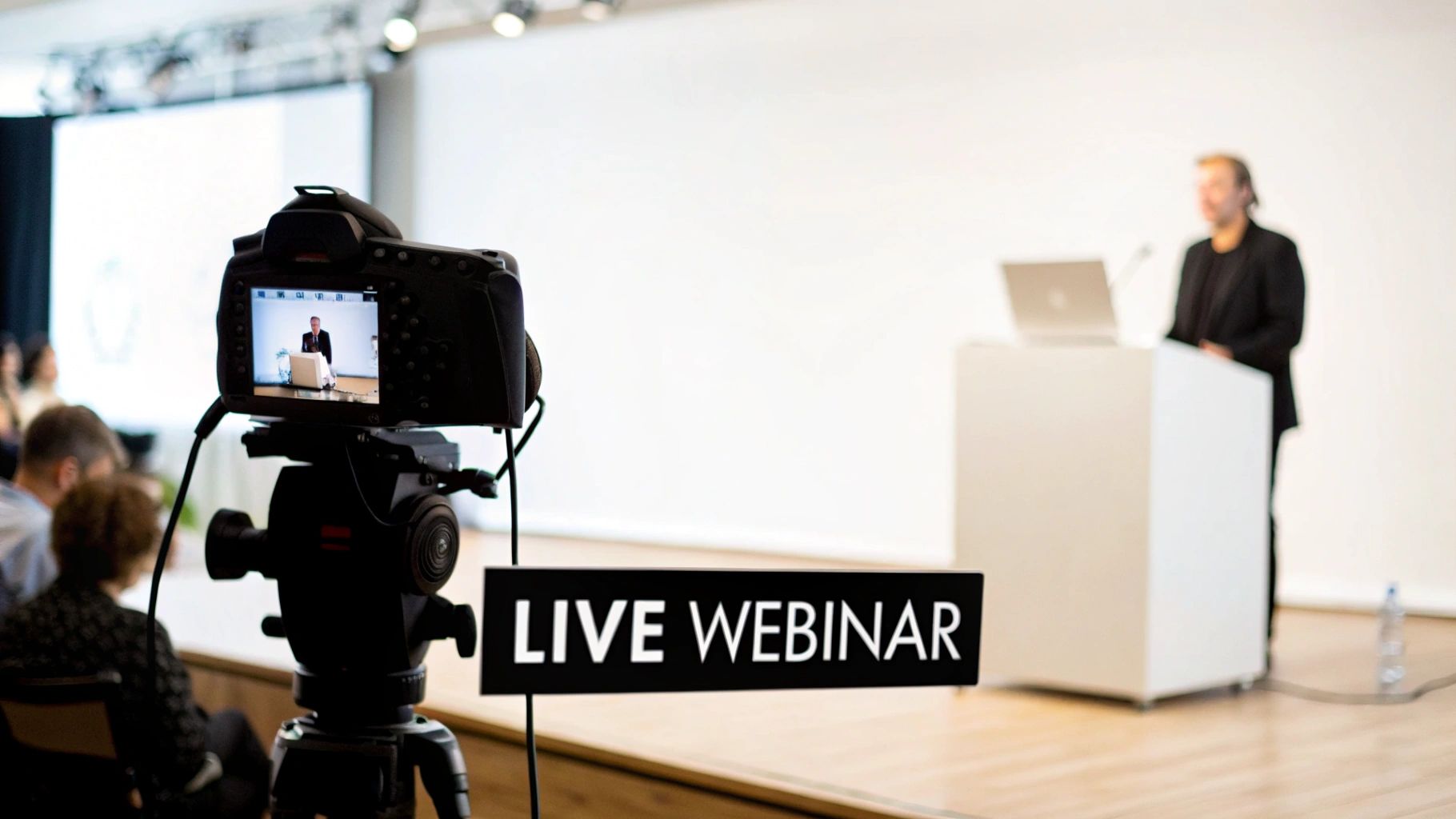
Events, whether virtual webinars or in-person workshops, offer a powerful way to connect with your audience in a high-impact, interactive format. Instead of just telling potential clients about your expertise, you’re creating an experience where they can learn from you directly, ask questions, and see your value proposition in real-time.
For service businesses, this is about building community and creating a direct pipeline of highly-qualified, educated leads. Events allow you to condense your thought leadership into a focused, engaging session that accelerates trust and positions your company as a central hub in your industry.
Why It Works for Service Businesses
Hiring a service provider is a high-consideration decision that requires significant trust. Webinars and events shorten the sales cycle by delivering immense value upfront. An attendee who spends an hour learning from you has already invested their time and attention, making them far more likely to see you as the go-to expert when they are ready to buy.
How to Implement This Strategy
- Start with a Focused Webinar: Before planning a large conference, begin with a simple, 60-minute webinar. Focus on solving one specific, painful problem for your ideal client. Use a compelling title like "The 3-Step Framework to Double Your Agency's Leads Without Paid Ads."
- Promote Across Multiple Channels: Use your email list, social media, and content channels to drive registrations. Partner with complementary businesses to co-host or cross-promote the event to expand your reach.
- Plan Your Post-Event Follow-Up: The real work begins after the event ends. Create an automated email sequence for attendees that offers the recording, a special offer related to your service, and a clear call-to-action to book a consultation.
Key Insight: Treat your event as a product, not a meeting. Design the experience from registration to follow-up to deliver maximum value and seamlessly guide attendees toward becoming clients.
Micro Case Study: ConvertKit
ConvertKit, an email marketing platform for creators, excels at using event marketing. Their free online summits, like "The Creator Sessions," bring together top experts to teach creators how to grow their businesses. By hosting these high-value educational events, they not only generate thousands of qualified leads but also reinforce their brand as the central tool for serious creators, driving both new sign-ups and customer loyalty.
- Business Stage: Great for Growth-Stage businesses to scale lead generation, but Early-Stage can use smaller webinars for credibility.
- Cost & Time: Low financial cost for webinars ($50-$200 for software), but high time investment (15-30 hours for prep and promotion).
- Key Metrics: Registration rate, attendance rate, post-webinar consultation bookings, and sales conversion rate from attendees.
10. Referral Programs & Viral Loop Marketing
Happy clients are your best salespeople, but they often need a nudge to spread the word. A structured referral program transforms casual word-of-mouth into a predictable growth engine. It's about creating a simple, rewarding system that incentivizes your existing clients to introduce your services to their network, scaling trust faster than any ad campaign ever could.
This isn’t just about offering a discount; it's about building a viral loop where one happy client systematically leads to another. For service businesses, where a single referral can be worth thousands, this is one of the most cost-effective marketing strategies you can deploy. It leverages the social proof of a trusted peer, which is the gold standard in service-based sales.
Why It Works for Service Businesses
Trust is the currency of the service industry. A recommendation from a respected friend or colleague instantly overcomes skepticism and shortens the sales cycle dramatically. Referral programs formalize this process, making it easy for advocates to share and rewarding them for their loyalty, creating a flywheel of high-quality, pre-qualified leads.
How to Implement This Strategy
- Design a "Double-Sided" Incentive: The most effective programs reward both the referrer and the new client. For example, the referring client gets a 10% credit on their next invoice, and the new client receives 10% off their first project. This creates a win-win scenario.
- Make Sharing Effortless: Provide your clients with a unique, shareable link or a simple email template. The process should take less than 30 seconds. The more friction you remove, the more referrals you will get.
- Promote the Program Actively: Don't hide your referral program. Mention it in your email signature, on invoices, during client check-in calls, and in your project offboarding process. Make it a visible and consistent part of the client experience.
Key Insight: Frame your referral program not as a transactional request, but as a way for your best clients to help their peers succeed. The incentive is a "thank you," not the primary motivation.
Micro Case Study: ConvertKit
Email marketing platform ConvertKit built a powerful engine for growth through its affiliate program, a model service businesses can easily adapt. By giving creators a recurring 30% commission for every person they refer, they incentivized their most passionate users to become active advocates. This created a viral loop where successful creators taught others how to succeed, recommending ConvertKit as the essential tool, fueling exponential and highly targeted growth.
- Business Stage: Great for all stages, but especially powerful for Growth-Stage businesses with a happy client base to activate.
- Cost & Time: Low financial cost (pay-for-performance). Moderate time investment to set up and promote the system.
- Key Metrics: Referral rate (percentage of clients who refer), lead-to-close rate for referred clients, and viral coefficient (k-factor).
Top 10 Service Marketing Strategies Comparison
| Strategy | Implementation (🔄 Complexity) | Resources (⚡ Requirements & Speed) | Expected Outcomes (📊 Results & ⭐ Effectiveness) | Ideal Use Cases (💡 Tips / Key advantages) |
|---|---|---|---|---|
| Content Marketing & Thought Leadership | 🔄🔄🔄 — Editorial process, consistent publishing | ⚡⚡ — Time‑intensive content creation, SEO skills | 📊⭐⭐⭐ — Evergreen traffic, authority; ROI in 3–6 months | 💡 Best for service founders building trust; repurpose formats, target long‑tail keywords |
| Community Building & Network Effects | 🔄🔄🔄 — Ongoing moderation and engagement work | ⚡⚡ — Community manager, platform & event costs | 📊⭐⭐ — Sticky engagement, referrals; value rises with scale | 💡 Start narrow (niche), host live events, showcase member wins |
| Partnership & Co‑Marketing Collaborations | 🔄🔄 — Outreach, negotiation and coordination | ⚡⚡ — Shared resources; moderate time for alignment | 📊⭐⭐ — Expanded reach & credibility; variable ROI by partner | 💡 Target complementary partners, define clear win‑win agreements |
| Email Marketing & Newsletter Strategy | 🔄🔄 — Content cadence + automation setup | ⚡ — Low cost per contact; requires list building & copywriting | 📊⭐⭐⭐ — High ROI and direct conversions; strong retention channel | 💡 Segment lists, use strong opt‑ins, include case studies and clear CTAs |
| Paid Advertising (PPC, Social, Display) | 🔄🔄 — Campaign setup + continuous optimization | ⚡⚡⚡ — Requires ongoing budget and specialist skills | 📊⭐⭐ — Immediate traffic and measurable ROI; costly at scale | 💡 Use to test messaging, track ROI, leverage retargeting/lookalikes |
| Search Engine Optimization (SEO) | 🔄🔄🔄 — Technical + content + link building work | ⚡⚡ — Time + SEO tools or agency investment | 📊⭐⭐⭐ — Sustainable, compounding organic traffic; slower to start | 💡 Build pillar pages, optimize for featured snippets and long‑tail queries |
| Influencer Marketing & Ambassador Programs | 🔄🔄 — Outreach, vetting and brief management | ⚡⚡ — Costs vary; micro‑influencers often cost‑effective | 📊⭐ — Authentic niche reach; ROI can be inconsistent | 💡 Favor micro‑influencers, use affiliate tracking, cultivate long‑term relationships |
| Product‑Led Growth (PLG) & Freemium Models | 🔄🔄🔄 — Product design, gating and onboarding work | ⚡⚡ — Product development and support investment | 📊⭐⭐ — Low CAC potential; conversions depend on demonstrated value | 💡 Provide clear upgrade triggers, measure activation/time‑to‑value |
| Event Marketing & Webinars | 🔄🔄🔄 — Event planning, promotion, speaker coordination | ⚡⚡ — Production costs and promotional resources | 📊⭐⭐ — High‑quality leads and deep engagement; episodic impact | 💡 Start with small webinars, repurpose recordings, offer sponsorship tiers |
| Referral Programs & Viral Loop Marketing | 🔄🔄 — System setup, tracking, and fraud controls | ⚡ — Low incremental cost if product is viral | 📊⭐⭐⭐ — Can drive exponential growth if viral coefficient is strong | 💡 Make referrals frictionless, use double‑sided rewards, track viral metrics |
Stop Guessing, Start Implementing: Your Next Move
We’ve just navigated ten powerful marketing strategies for service businesses, each with the potential to transform your client acquisition process and build a sustainable brand. From the foundational, long-term power of Content Marketing and SEO to the rapid, scalable growth offered by Paid Advertising and Referral Programs, you now have a comprehensive playbook at your fingertips.
But information without action is just noise. The biggest mistake you can make now is feeling overwhelmed and trying to implement everything at once. That approach leads to scattered efforts, diluted results, and inevitable burnout. The real secret to success lies not in doing more, but in doing the right things with relentless focus.
From Theory to Action: Choosing Your Path
Think of this article not as a checklist to complete, but as a menu to choose from. Your ideal strategy depends entirely on where your service business is today and where you want it to go tomorrow.
For the Early-Stage Founder or Freelancer: Your primary goal is to build authority and trust. Your focus should be on strategies that create a foundation and generate initial traction with minimal cash outlay.
- Your Core Stack: Content Marketing & Thought Leadership paired with a robust Email Marketing & Newsletter Strategy. This combination allows you to attract an audience with your expertise and build a direct, owned relationship with potential clients. It’s a slow burn, but the compound interest is massive.
For the Scaling Agency or Established Consultant: You have a proven offer and a steady stream of clients, but you're ready for exponential growth. Now is the time to build systems and leverage others to expand your reach.
- Your Growth Levers: Partnership & Co-Marketing Collaborations are your fastest path to new, qualified audiences. Layering on a formalized Referral Program turns your happy clients into a dedicated, cost-effective sales force. These strategies multiply your efforts without requiring you to be the sole engine of growth.
The most successful service providers don’t have a secret marketing weapon. They have a deep understanding of one or two core channels that align perfectly with their business model, their ideal clients, and their personal strengths. They commit, they measure, and they iterate.
Your Commitment to Consistent Execution
Let’s be clear: reading this article was the easy part. The real work begins now. Choose your one or two focus areas. Break them down into small, manageable steps. Schedule time on your calendar to execute, just as you would for client work. Track your key metrics, whether it's website traffic, newsletter subscribers, or discovery calls booked.
Key Takeaway: The difference between a struggling service provider and a thriving one is not the knowledge of these strategies, but the discipline to execute one or two of them consistently over time.
Mastering these marketing strategies for service businesses is about more than just getting clients. It's about building a predictable, resilient business that gives you the freedom and impact you set out to achieve. It’s about transitioning from a reactive freelancer constantly hunting for the next gig to a proactive business owner with a system that attracts ideal clients to you.
Pick your path. Commit to the process. The growth you're seeking is on the other side of that focused, consistent action.
Ready to turn these strategies into a well-oiled system? Remotepreneur provides the playbooks, community, and expert coaching to help you scale your service business without the guesswork. Join a network of ambitious founders who are implementing these very tactics to build their remote-first empires at Remotepreneur.
